

Once an organization has grasped the concept of an AI Workforce, prepared its AI Workforce Readiness, and built capability through AI Skills Customer Operations and AI Skills Development, the next critical step is deciding "how will we use AI safely, with quality, and in a way people can trust?"
This is why AI Governance Customer Operations has become such an important topic for modern organizations — especially businesses where customer service, the Contact Center, or Customer Operations sits at the heart of what they do.
Customer service is not only about answering faster. It also touches personal data, the accuracy of answers, service standards, legal risk, customer trust, and brand reputation.
AI may help service teams work faster, analyze data better, and cut repetitive work. But without a clear governance approach, AI can create risk just as easily — giving wrong answers, using data inappropriately, misreading context, or leaving customers feeling they were never properly looked after by a person.
AI Governance Customer Operations is therefore not a matter for IT or Compliance alone. It is a whole-organization effort to design standards for AI use that align with Customer Experience goals and business impact.
AI Governance Customer Operations is a framework for overseeing the use of AI in customer service so that it is safe, accurate, transparent, standardized, and risk-controlled — covering data, process, people, technology, service quality, and measurement.
AI Governance Customer Operations acts as the "shared rulebook" that lets an organization use AI with confidence, and lets teams know where the boundaries are, how to work within them, and what to watch out for.
In customer service, speed matters — but accuracy and trustworthiness matter just as much, because a single wrong answer can affect customer confidence, the experience delivered, and the organization's risk exposure.
AI can summarize information, draft responses, and suggest ways to resolve an issue. But it can equally give information that is incomplete or ill-suited to the customer's context.
In customer service — particularly cases involving service terms, finances, personal data, or complaints — the organization needs a way to review AI answers before they are used, to prevent mistakes and reduce service-quality risk.
Customer Operations works with a great deal of customer data: contact history, account details, problem descriptions, and personal information.
Using AI without a clear data approach can create risk — using more data than necessary, applying sensitive data in the wrong context, or disclosing information unintentionally.
AI Governance must therefore make clear which categories of data may be used, which must be masked, and which must never be entered into an AI tool.
In earlier articles we discussed Human-in-the-loop as one of the key skills and approaches for working alongside AI. But Human-in-the-loop only becomes real when the organization defines the rules and handover points clearly.
Severe complaints, cases involving personal data, cases where the AI is not confident in its answer, or cases requiring policy judgement must always have a person review or decide.
Without governance, each employee may use AI differently — one to look up answers, another to draft messages, another to summarize cases — with no shared standard for how to verify the output or where the limits lie.
AI Governance Customer Operations creates that shared standard, so the customer service team uses AI consistently, safely, and to a higher quality.
Customers do not need to know every step of how an organization uses AI. But they do need service that is accurate, safe, and human.
Good AI Governance keeps AI use from eroding customer trust, and gives leadership confidence that AI is being used to raise Customer Experience rather than to add business risk.
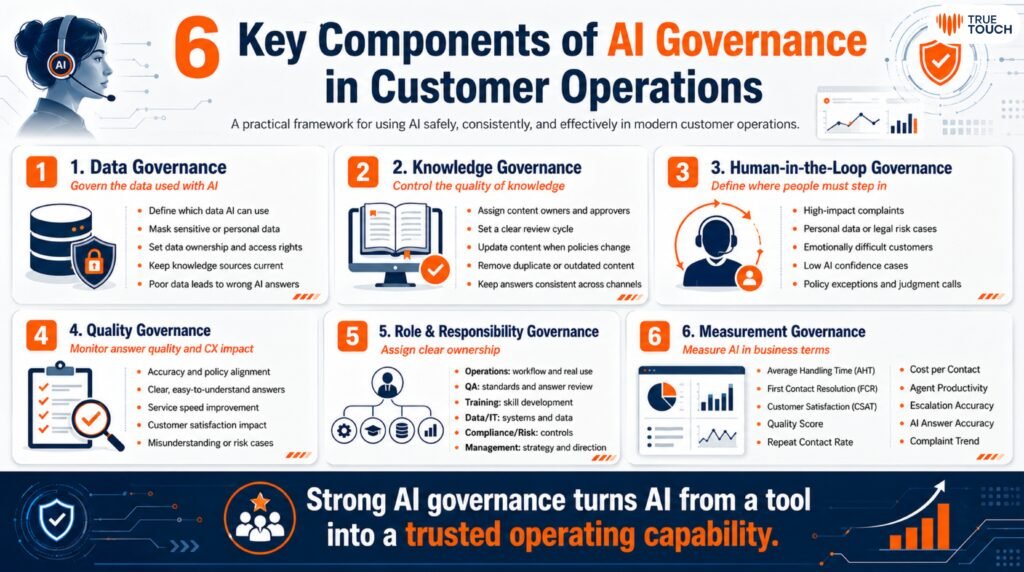
Data Governance is the foundation of AI Governance, because AI performs well only when the data behind it is of good quality, accurate, and properly managed.
In Customer Operations, incorrect data can lead the AI to give the wrong answer — with a direct effect on the customer's experience.
AI used in customer service usually relies on a Knowledge Base to suggest answers or help agents find information, which makes Knowledge Governance especially important.
Human-in-the-loop Governance means making clear which cases AI may help carry out, and which cases require a person to review or decide.
Setting these conditions lets AI work effectively without diminishing the quality and trustworthiness of the service.
Using AI in Customer Operations calls for continuous quality checks — not just whether the AI works, but how its use affects service quality.
Measuring AI should not stop at how many times it was used. It must show what AI produces in terms of Productivity, Quality, Customer Experience, and Business Impact.
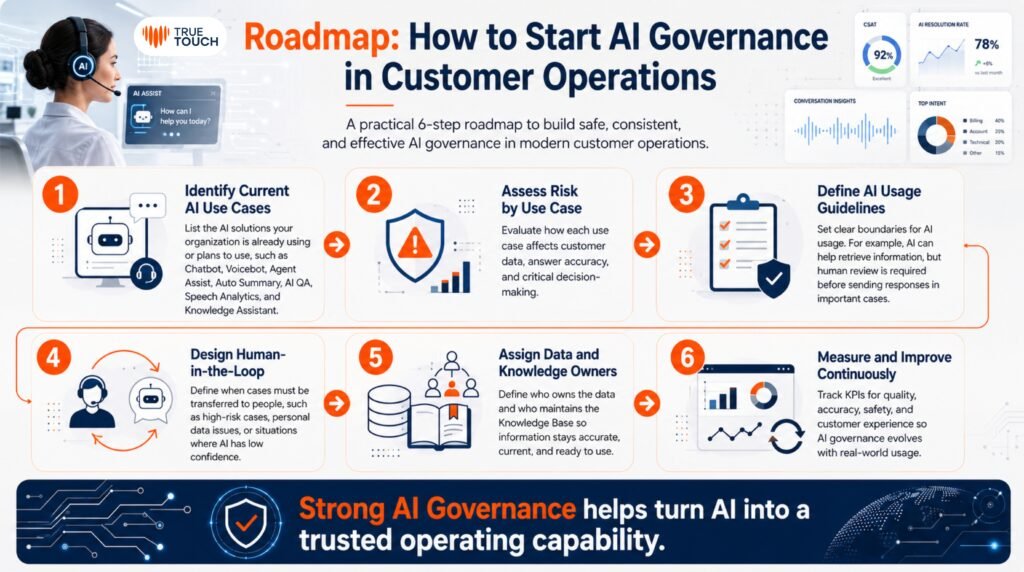
Start by gathering where the organization uses AI today — Chatbot, Voicebot, Agent Assist, Auto Summary, AI QA, Speech Analytics, or Knowledge Assistant.
Define the boundaries clearly — for example, AI may be used to help find information, but a person must review before the answer is sent in significant cases.
Name who is responsible for the data and who maintains the Knowledge Base, so the content stays accurate, current, and ready to use.
Track KPIs for quality, accuracy, safety, and customer experience, so AI Governance evolves alongside real-world use.
AI Governance Customer Operations is the next step on from AI Workforce, AI Workforce Readiness, AI Skills Customer Operations, and AI Skills Development. Once an organization has prepared its people and built their skills, it still needs a clear framework for use, so that AI is applied in a direction that is safe and genuinely valuable.
Without governance, employees may have the skills to use AI but apply them inconsistently, or not know where their responsibility begins and ends.
This is the point at which AI shifts from an experimental tool to a genuine part of the Customer Operations operating model.
AI Governance Customer Operations is the foundation for using AI in customer service sustainably. It lets an organization use AI safely and to a standard, and builds confidence with customers, employees, and leadership alike.
In future, the organizations that use AI well will not be the ones with the most tools, but the ones that govern AI best — across data, quality, risk, process, and customer experience.
Because in the end, AI may make service faster and more efficient, but customer trust still comes from service that is accurate, transparent, and understands people.
True Touch is ready to partner with modern organizations to raise the level of their Customer Operations — from Contact Center strategy, building an AI Workforce, and designing AI Skills Development, to workflow and Human-in-the-loop design, and using Data & AI to elevate Customer Experience safely and measurably.
A1: AI Governance Customer Operations is a framework for overseeing the use of AI in customer service so that it is safe, accurate, transparent, and standardized — covering data, answer quality, Human-in-the-loop, risk, and business outcome measurement.
A2: Customer service touches customer data, answer accuracy, and brand trust. Without AI Governance, an organization risks inappropriate data use, incorrect answers, or service that loses its human touch.
A3: Start by identifying the AI use cases already in place, assessing their risk, setting guidelines for AI use, designing the Human-in-the-loop, assigning owners for the data and Knowledge Base, then measuring and improving continuously.