

Over the past few years, AI has moved from a tool that supports work to one of the "main drivers" of the modern organization — particularly in Customer Operations, the Contact Center, Customer Experience, and customer service work, which has to cope with large volumes of data, rising customer expectations, and the need to serve faster, more accurately, and more personally.
The term AI Workforce therefore does not mean replacing people with AI. It means building a new way of working in which "people work alongside AI" effectively — letting AI take on repetitive work, data analysis, insight summaries, and work that demands speed, while people remain central to work that requires understanding, empathy, contextual judgement, and creating a good experience for the customer.
For organizations that care about Customer Experience, building an AI Workforce is not a matter for IT alone. It is an organization-wide priority, because it touches business strategy, team structure, employee skills, service standards, data governance, and customer trust.
AI Workforce is the idea of designing a modern workforce that can work systematically alongside artificial intelligence, combining the strengths of people and technology to raise efficiency, cut repetitive work, improve the quality of decisions, and create measurable business results.
For example, AI may summarize the conversation after a call ends, suggest answers from the Knowledge Base, analyze customer sentiment, detect complaint themes, or help a supervisor see problem trends in real time — while employees continue to do the important work of listening, understanding the situation, communicating with a human touch, and handling complex cases.
2026 will be the period when many organizations move from "trialling AI" to "using AI for real at an operational level", especially in customer-facing work — because businesses can no longer compete on speed alone. They must compete on quality, experience, and the ability to adapt.
As simple work is increasingly handled by self-service or bots, the cases that reach an employee tend to be complex ones demanding stronger analysis and communication skills.
Without AI or data-driven operations to help, the service team may never see the full picture of the customer — making problems slower and less consistent to resolve.
Employees need more than system skills. They need to understand how to work alongside AI, know its limits, and be able to use it to genuinely raise the quality of their work.
Organizations that prepare sooner have the chance to build an advantage in Productivity, Service Quality, Customer Experience, and Business Agility.
From working in Contact Center and Customer Experience, one thing is clear: bringing AI into customer service does not succeed through technology alone. It succeeds by redesigning the work to fit the people, the process, and the business goals.
Many organizations start by looking for tools — a chatbot, voicebot, Speech Analytics, AI QA, or a dashboard. But in practice, if the team does not yet understand the process, the data is not ready, the Knowledge Base is unclear, or employees are unsure how AI is meant to help, the AI project may not deliver the results expected.
Once an organization can answer these clearly, AI stops being just a new tool and becomes part of an operating model that helps the team work better.
As AI takes on a bigger role, people's work does not disappear. It shifts from repetitive execution toward work demanding higher skill — particularly in five key roles.
The agent of the future will not simply answer questions from a script. They will need to analyze the situation, understand the customer's emotion, choose the right way to communicate, and use AI as an assistant for finding information or suggesting a way to resolve the issue.
Supervisors will use AI data to see service quality trends sooner — the issues customers complain about most, the sentiment of conversations, or the employees who need extra coaching.
QA traditionally assessed a sample of conversations. AI can analyze far more of them, making patterns of problems much clearer.
Even so, people must still set the standards, interpret the context, and judge quality in complex cases — because customer service is not measured only by saying the correct words, but by the appropriateness of the communication and the outcome the customer receives.
As AI changes the shape of work faster, training a few times a year may not be enough. Organizations need continuous learning systems — microlearning, AI coaching, case-based learning, and using frontline data to shape the curriculum.
As AI reduces repetitive work, employees should have more time to look for ways to improve the service — analyzing customer pain points, proposing ways to cut repeat contacts, or finding opportunities to raise First Contact Resolution.
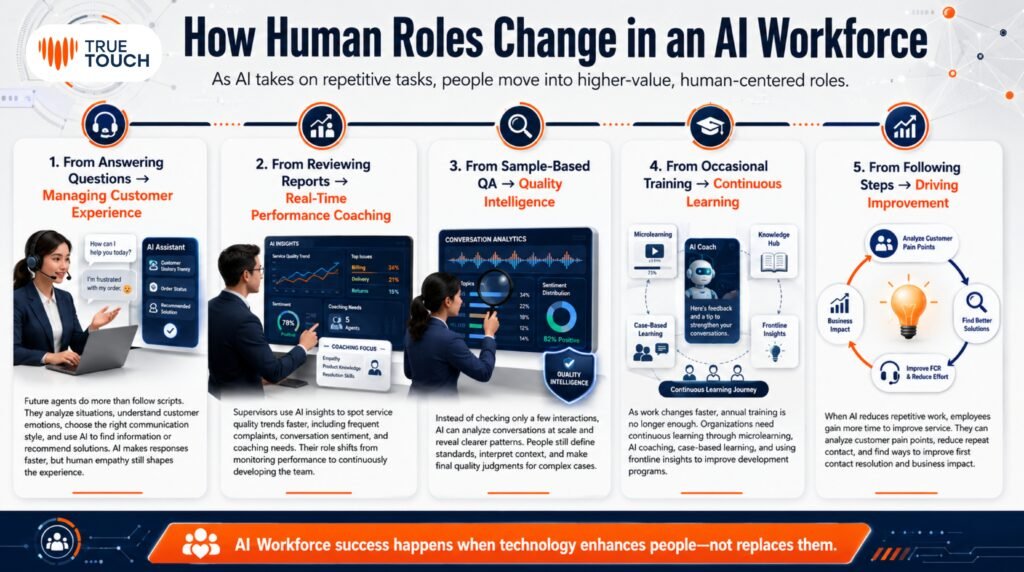
AI Workforce is not about replacing people with AI. It is about designing new roles so people and technology work together more effectively — especially in Customer Operations and the Contact Center, where customers must be served quickly and accurately while the human touch is kept in balance.
For organizations getting started, what matters is not only choosing an AI tool. It is understanding first how people's roles will change, which parts of the work AI should help with, and how the customer service team must adjust its thinking to be ready for this new way of working.
In the next article we will take a more practical view of how an organization prepares its people — from building an AI mindset, to reskilling and upskilling, designing Human-in-the-loop, adjusting the operating model, and measuring results in a way that connects to business impact.
Read the next article to prepare your Customer Operations team to work with AI confidently, and raise Customer Experience to meet what a modern organization needs
A1: AI Workforce is the idea of designing a modern workforce that can work systematically alongside AI — letting AI handle repetitive work, data analysis, or work that demands speed, while people continue to handle work requiring understanding, judgement, and a human touch.
A2: No. AI Workforce does not mean replacing employees wholesale. It raises the role of people so they do more valuable work, with AI as an assistant that improves efficiency, cuts repetitive work, and lets employees focus more on the work that needs human skill.
A3: Because 2026 is when many organizations start using AI for real at an operational level, especially in customer service. Organizations that prepare an AI Workforce sooner have the chance to raise productivity, improve service quality, reduce cost, and deliver a better Customer Experience.
2. Microsoft. (2025). 2025 Work Trend Index: The Year the Frontier Firm is Born.Read the Microsoft WorkLab report
3. Gartner. (2025). Gartner Predicts Agentic AI Will Autonomously Resolve 80% of Common Customer Service Issues by 2029.Read the Gartner analysis
4. McKinsey & Company. (2025). Superagency in the Workplace: Empowering People to Unlock AI's Full Potential at Work.Read the McKinsey & Company report