
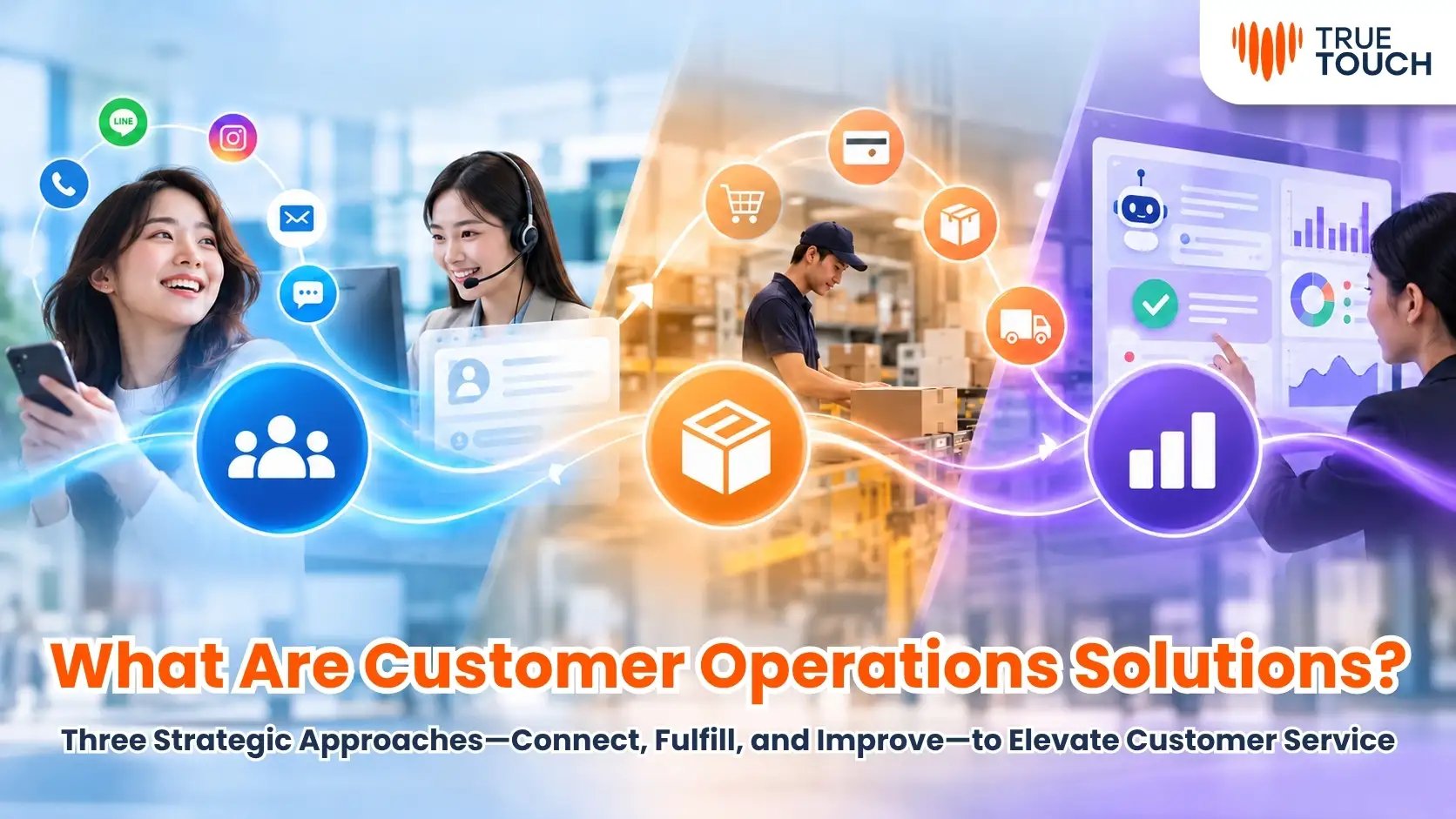
Three Approaches : Connect, Fulfill, and Improve to Elevate Customer Service
A great Customer Experience is not created only when an Agent answers a call or responds to a Chat quickly.
Behind every customer interaction, there may be multiple systems managing Customer Data, Case handoffs, Payment verification, coordination with Operations, and post-service quality monitoring.
When these components operate in isolation, customers may experience a fragmented journey even when each individual team performs its role effectively.
This is why organizations are increasingly focusing on Customer Operations Solutions technologies designed to connect Customer Interactions, Operational Processes, and Quality Management so they work together more effectively.
Based on True Touch’s more than 20 years of experience in Contact Center and Customer Experience, we have found that before selecting Technology, organizations should not begin by asking:
“What features does this system have?”
Instead, the more important question is:
“Where are the bottlenecks in our Customer Operations?”
Customer Operations Solutions are solutions or technologies that help organizations manage customer-related processes more effectively — from receiving Customer Interactions and executing operational activities to analyzing performance and continuously improving service quality.
The objective is not simply to Automate tasks, but to ensure that:
Customer → Agent → Process → Data → Quality
remain connected throughout the Customer Journey.
Salesforce reports that 88% of Service Leaders prioritize Technology Integration to connect data and reduce silos. Organizations that consolidate Service Channel Data on a Unified Platform are also 1.4 times more likely to report that their AI initiatives are “very successful” compared with organizations where data remains fragmented.
McKinsey similarly emphasizes the importance of managing Customer Journeys End-to-End rather than optimizing individual Touchpoints in isolation, because Customer Experience is shaped by a connected series of Interactions and Processes across the entire journey.
The first challenge often begins at the Frontline.
A customer may start with Chat today, call the Contact Center the next day, and send a Social Media message later while the information from each channel may still be stored in separate systems.
As a result, Agents may need to search across multiple screens for previous history, while customers may be required to repeat the same information.
In this situation, organizations do not simply need “more channels.” They need to CONNECT Customer Interactions and Customer Information.
Technology can help create a Unified Workspace that brings together Customer Profiles, Conversation History, Tickets, Cases, and Knowledge in a more accessible and connected view.
IBM highlights that customers increasingly expect continuity across service interactions, where each new Interaction should build on previous context rather than requiring customers to start over.
Business Challenge:
Fragmented Customer Data / Multiple Agent Systems / Disconnected Customer Context
Solution Approach:
CONNECT — TOUCHCONNEXTE
Responding quickly to customers may not be enough if their requests must still pass through multiple Manual Processes afterward.
For example:
Order → Payment → Branch → Delivery
If an Agent receives an Order in one system, verifies Payment in another, and then sends details to a branch through Chat or Email, multiple handoff points are created increasing the risk of delays, data re-entry, and Human Error.
The challenge is therefore not limited to Customer Interaction. It is about how effectively an organization can FULFILL a Customer Request by turning it into Operational Action.
McKinsey’s End-to-End Customer Journey perspective emphasizes that effective transformation should consider both the Customer-facing Journey and Back-office Processes together, rather than improving Technology or Operations independently.
Business Challenge:
Manual Handoffs / Multiple Disconnected Processes / Limited Order Visibility / Disconnected Customer Service and Operations
Solution Approach:
FULFILL — TOUCHDELI
Once Customer Interactions and Operations have been completed, another critical question remains:
“Do we have enough visibility into the quality of every service interaction?”
In Contact Centers with high Conversation volumes, QA teams may not be able to manually review every Interaction and therefore rely on Sampling.
Sampling remains valuable, but its limitation is that important Issues may exist within Conversations that are never selected for review.
AI and Automation can help screen and analyze a broader range of Interactions, enabling QA teams to identify Patterns, Risks, and Cases that require further investigation.
IBM explains that Contact Center Automation uses AI to reduce Routine and Repetitive Tasks, allowing employees to spend more time on complex customer issues and activities that require Human Expertise.
The objective is therefore not Automation alone, but the ability to transform large volumes of interaction data into Quality Intelligence.
Business Challenge:
Limited QA Sampling / High Manual Review Effort / Incomplete Issue Visibility / Difficulty Turning Data into Improvement
Solution Approach:
IMPROVE — QA Automation
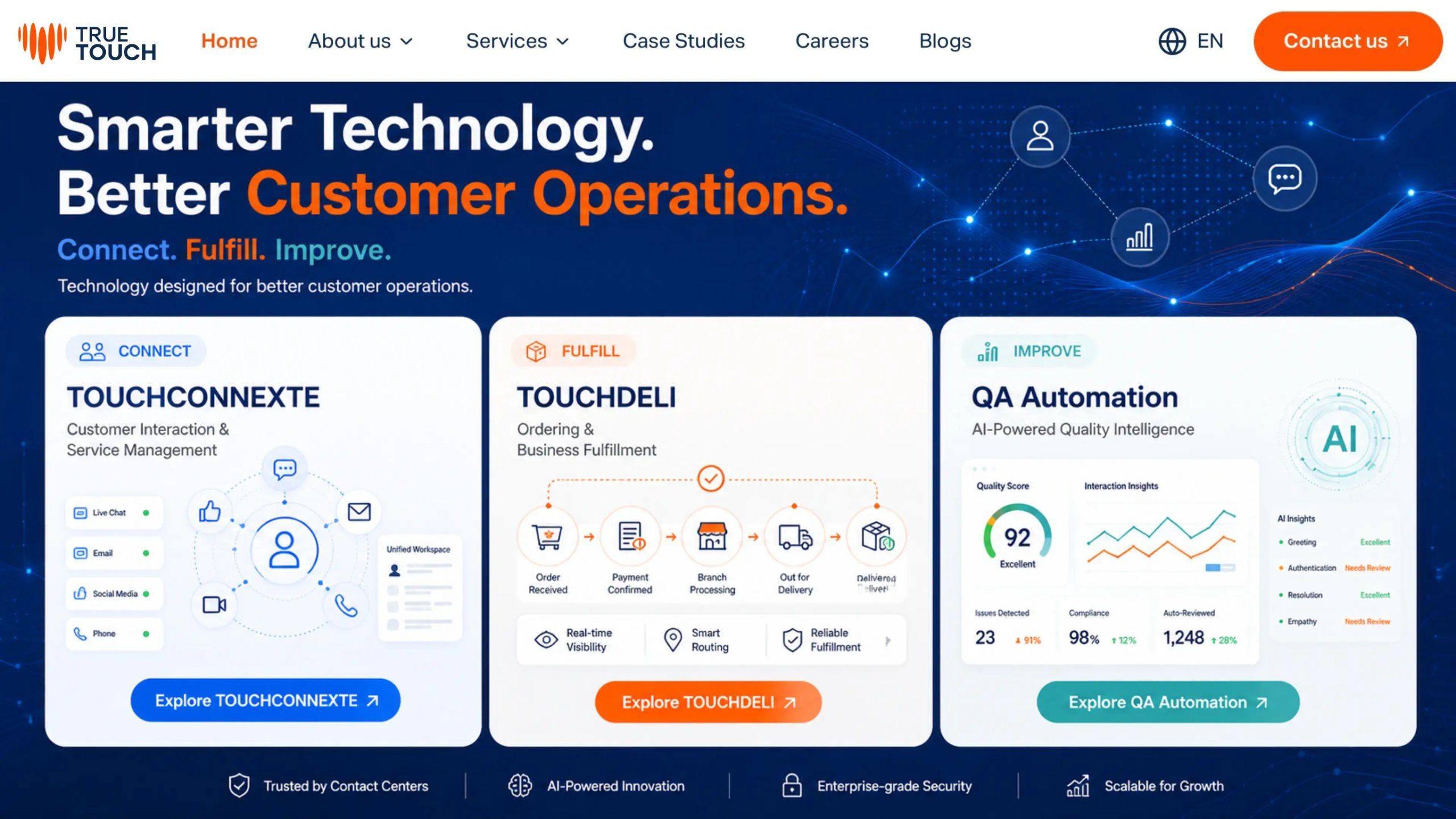
The three approaches serve different stages of Customer Operations and address different business challenges.
| If your challenge is... | Approach | Solution |
|---|---|---|
| Customer Data, Channels, and Cases are fragmented | CONNECT | TOUCHCONNEXTE |
| Customer Requests require multiple operational handoffs | FULFILL | TOUCHDELI |
| QA Coverage is limited and greater Quality Visibility is needed | IMPROVE | QA Automation |
Organizations do not need to implement all three Solutions at the same time.
The priority is to first identify which bottleneck has the greatest impact on Customer Experience and Operational Performance.
Based on our experience in Customer Operations, we recommend starting with the Business Problem before the Technology.
Organizations can begin by asking three simple questions.
If Agents need to access multiple systems, customers must repeat the same information, or Case History is difficult to retrieve, the organization may need to begin with Customer Interaction and Data Integration.
If teams still rely on Data Re-entry, Manual Follow-ups, or manual information handoffs between departments, it may be necessary to review Workflow and Fulfillment Processes.
If QA can review only a limited Sample or Management cannot clearly see Quality Patterns, AI and Automation may help expand visibility.
This approach aligns with IBM’s view that Customer Operations are evolving beyond efficiency alone toward creating stronger Customer Experience and Business Impact by combining AI with Human Expertise.
Investing in Technology does not automatically create a better Customer Experience.
If existing Processes remain complex, Data stays fragmented, and teams cannot effectively use Insights, new Technology may simply become another system employees need to manage.
The True Touch CX Technology Solutions approach therefore starts by viewing Customer Operations as one connected ecosystem.
CONNECT — Connect Customer Interactions
FULFILL — Connect Customer Requests with Operations
IMPROVE — Use AI and Data to continuously improve quality
The goal is to ensure that Technology does more than Digitize existing work. It should help create Smarter Customer Operations that deliver value for both Customers and the Business.
Whether your organization’s challenge lies in Customer Interaction, Operational Fulfillment, or Quality Management, the best starting point is to understand your Pain Points and Current Processes before selecting a Solution.
Discover the True Touch CX Technology Solutions that best fit your Customer Operations needs.
For more information, please contact:
Tel: +66(0)2088-8999
Email: [email protected]
Website: https://www.truetouch.co.th/en
Customer Operations Solutions are suitable for organizations with Customer Service, Contact Center, or Customer Operations functions that manage high volumes of Customer Interactions, multiple handoffs across teams, systems, or processes, and want to use Data and AI to improve both operational efficiency and service quality.
No. Organizations can begin with the Pain Point that has the greatest Business Impact and expand additional Solutions or Integrations based on their Processes, Technology Architecture, and Business Requirements.
In many cases, Customer Operations Solutions can be designed to Integrate with existing systems. However, the appropriate approach depends on factors such as existing platforms, APIs, Data Structures, Security Requirements, and the Scope of each project.
A Requirement Assessment should therefore be conducted before Implementation to determine the most appropriate Integration approach.