
5 Signs Your Business Needs a Centralized Customer Service System
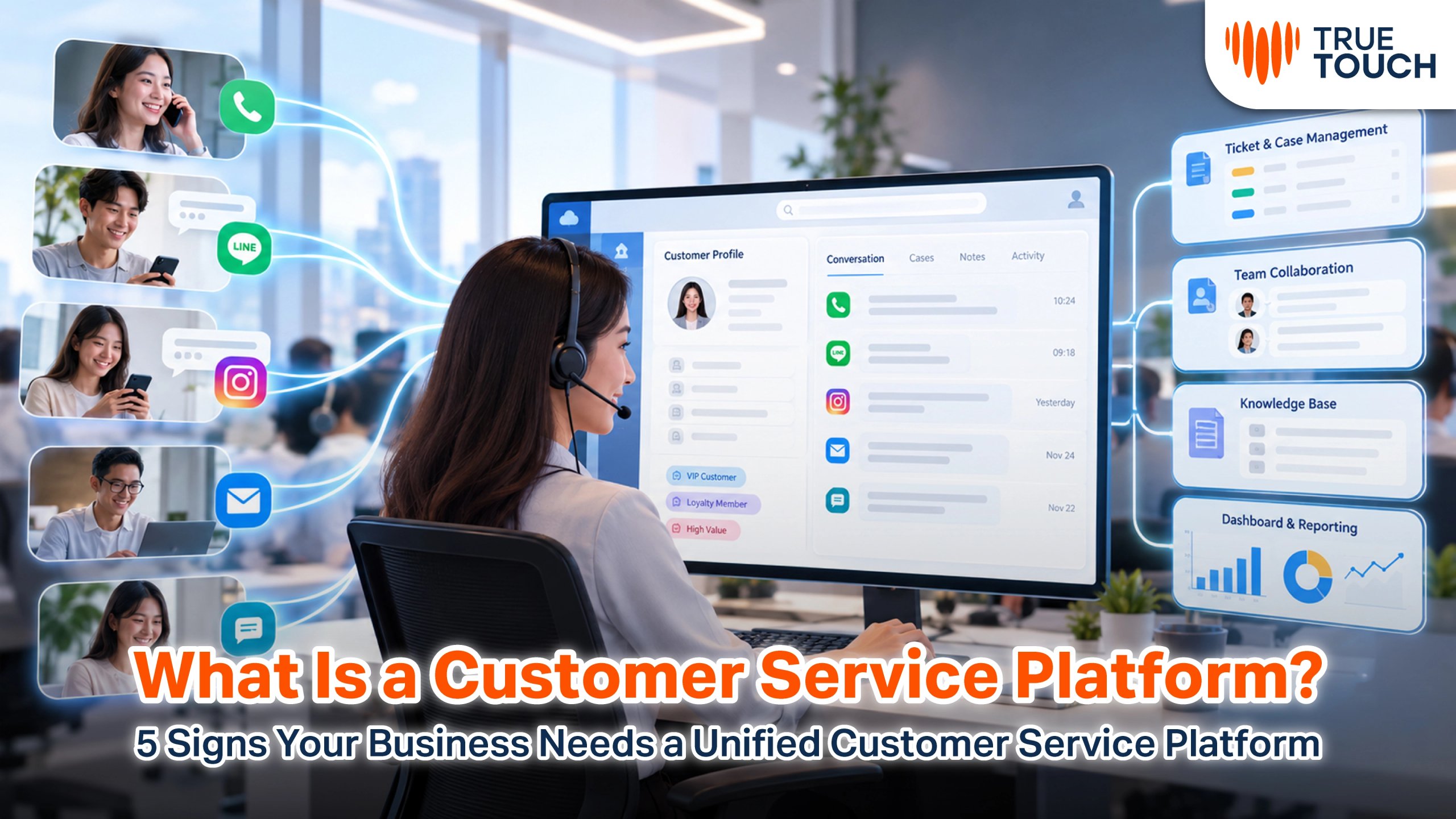
A customer may contact an organization through multiple channels — from Phone, Live Chat, Email, to Social Media. But the key question is: Are the data from all of those interactions connected?
In many organizations, Agents need to open multiple systems to search for information, review interaction history, or check Case status before they can respond to customers. As a result, a process that should take only a few minutes can become unnecessarily complex.
Based on True Touch’s more than 20 years of experience in Contact Center Management and Customer Experience, we have found that Customer Service challenges do not arise only from the increasing number of channels, but also from the fact that Customer Data, Conversations, and Service Processes are not yet connected within a single view.
One approach to addressing this issue is to use a Customer Service Platform to bring together the key data and processes involved in customer service within one system.
A Customer Service Platform is a platform that helps organizations manage Customer Interactions and customer service processes in a centralized way, allowing Agents and relevant stakeholders to access the information they need from a single Workspace.
In general, the Platform may include:
The goal is not simply to “combine systems,” but to enable Agents to clearly see and understand the Customer Context and continue the service process without having to search for information from scratch every time.
This becomes even more important as customer expectations continue to rise. Salesforce reports that 82% of Service Professionals say customer expectations are higher than they used to be, while service employees spend only 46% of their working time directly serving customers. The remaining time is spent on Administration and other internal tasks.
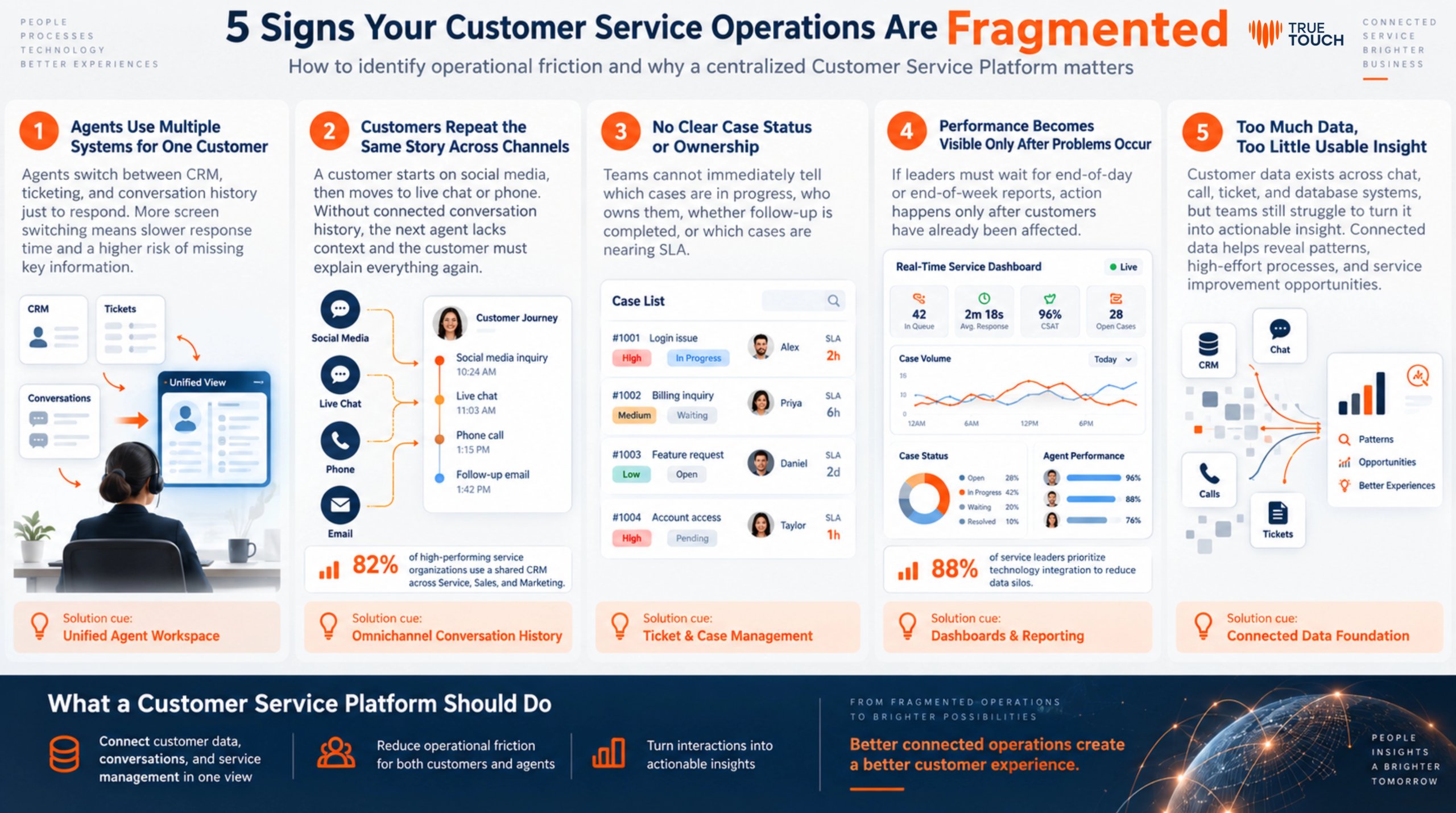
Consider what happens when a customer contacts your organization. Does the Agent need to open one CRM screen, another Ticket system, and then search for previous Conversation history in yet another system?
If the answer is “yes,” this may be the first sign of Fragmented Customer Service Operations.
The more frequently Agents need to switch between systems, the more time they spend searching for information, while also increasing the risk of missing important details.
A Customer Service Platform with a Unified Agent Workspace can bring relevant information into a single view, enabling Agents to better understand the Customer Context and focus more on resolving customer issues rather than searching for information.
A customer may begin an inquiry through Facebook, then move to Live Chat, or call the Contact Center later.
If each channel does not share connected Conversation History, the next Agent may not know what happened previously, forcing the customer to explain the same issue again.
From a Customer Experience perspective, this is unnecessary Friction.
An Omnichannel Customer Service Platform should therefore enable teams to view Conversation History and Customer Context continuously across channels.
Salesforce reports that 82% of high-performing Service Organizations use the same CRM Platform across Service, Sales, and Marketing, highlighting the importance of creating a connected Data Foundation.
Another common problem occurs when a customer contacts the organization and the team cannot immediately answer questions such as:
What stage is the Case currently in?
Who is responsible for it?
Has a Follow-up already been completed?
Which Cases are approaching or exceeding the SLA?
When work tracking depends too heavily on Email, Spreadsheets, or internal messaging, controlling the Service Level becomes more difficult as the number of Interactions increases.
Ticket & Case Management is therefore an important component of a Customer Service Platform because it helps clearly define the Owner, Status, Priority, and History of each Case.
If Team Leaders need to wait until the end of the day or the end of the week for the team to compile Reports before they can see that the Queue has increased, Cases are pending, or Response Time has become an issue, corrective action will only happen after customers have already been affected.
Dashboards and Reporting connected to Service Operations can help teams gain faster visibility into data such as:
Interaction Volume, Queue, Response Time, Case Status, and Agent Performance
This information can then be used to plan Workforce, Coaching, or Process Improvements in a more structured way.
Salesforce also reports that 88% of Service Leaders prioritize Technology Integration to unify data and reduce Data Silos, reflecting how connected data is becoming a fundamental part of Service Operations.
Many organizations have large volumes of Customer Data, but that data may still be separated across Chat, Call, Ticket, or Customer Database systems.
The problem is therefore not that there is “no data,” but rather that the data is not yet in a format that teams can easily use.
When Customer Interaction and Service Management data are connected within the same Platform, organizations can gain better visibility into patterns such as:
What topics customers contact the organization about most frequently
Which types of Cases take the longest to resolve
Which channels have the highest Interaction Volume
Or which Processes create the highest Customer Effort
This information can then become an input for improving the Customer Journey and Service Strategy.
Choosing a Customer Service Platform should not be based solely on the number of Features available. It should begin with the organization’s actual operating processes.
Based on True Touch’s experience in Contact Center Operations, we believe that a practical system should support at least three key areas.
Agents should be able to access the Customer Profile, Interaction History, and related Cases from a single point in order to understand the Context before providing service.
Teams should be able to create, track, Assign, and Escalate Tickets or Cases while clearly seeing the current work status.
Service data should be able to support analysis of Performance, Customer Issues, and opportunities to improve Service Operations.
Under the concept of True Touch CX Technology Solutions — Connect. Fulfill. Improve.
TOUCHCONNEXTE is designed as the CONNECT solution to help organizations better understand and manage Customer Interactions through a more connected system.
The Platform covers Customer Information, Omnichannel Conversations, Ticket & Case Management, Unified Agent Workspace, Knowledge Base, and Dashboard & Reporting.
It can also be customized to suit the Service Processes and roles of Agents, Team Leaders, and Admins within each organization.
The key concept behind TOUCHCONNEXTE is therefore not to add another Software system for Agents, but to reduce information fragmentation and create a Workspace that enables customer service teams to work more continuously.
Although a Customer Service Platform can help reduce complexity, this does not mean every organization needs to replace all existing systems.
Before making a decision, organizations should begin by analyzing the Current Process, for example:
Where is customer information currently stored?
How many systems does an Agent need to use for one Interaction?
Where does Manual Work or Data Re-entry occur?
Where do Cases get lost or become pending?
And which data needs to be Integrated with existing systems?
Some organizations may require an entirely new Platform, while others may begin by connecting data or adjusting certain Workflows first.
The right Technology should therefore begin with the Business Problem and Operational Requirements, not with the Feature List.
This is a key principle that helps organizations invest in Technology that supports real operational needs and creates long-term Business Impact.
If your Agents still need to open multiple systems, customers have to repeat the same story, or your team still finds it difficult to track Customer Cases, it may be time to review whether your current Customer Service Operations are connected enough.
Discover how TOUCHCONNEXTE can help connect your organization’s Customer Interactions, Customer Information, and Service Management.
For more information, please contact:
Tel: +66(0)2088-8999
Email: [email protected]
Website: https://www.truetouch.co.th/en
CRM typically focuses on storing and managing Customer Data and Customer Relationships, while a Customer Service Platform places greater emphasis on additional service processes such as Conversations, Tickets, Cases, Knowledge Base, Agent Workspace, and Service Performance.
However, many Platforms can combine CRM and Service Management capabilities within the same system.
This depends on the Platform and the Integration Scope.
An Omnichannel system can be designed to connect Interactions from multiple channels such as Live Chat, Social Media, Email, and other channels, enabling Agents to maintain greater continuity of Customer Context.
No. Development can begin by analyzing the organization’s Pain Points and Integration Requirements first, then determining whether specific parts of the existing environment should be Replaced, Integrated, or have their Workflows adjusted to suit the organization’s Business and Technical Environment.