


In an era where customers have more choices than ever, business competition is no longer measured solely by “product, price, or promotion.” Instead, it is increasingly measured by the “customer experience,” or CX.
Many organizations invest in Marketing and Sales to drive revenue, only to find that when customers actually reach out, their internal operations are not ready to support them, for example, being hard to contact, long wait times, disconnected data, having to repeat information multiple times, or receiving inconsistent answers across different channels.
This is why modern organizations must prioritize CX Transformation, the transformation of work processes, technology, people, and data, in order to systematically create a better Customer Experience.
Because in 2026, Customer Experience is not merely a “service function” but one of the “core strategies” that enables an organization to grow sustainably.
CX Transformation is the transformation of how an organization manages its Customer Experience so that it can deliver a better experience at every Touchpoint, systematically connecting People, Process, Technology, and Data together.
CX Transformation does not mean simply investing in new technology such as building a Chatbot or adding service channels. It means reshaping the organization's entire operating system so that it can serve customers better, faster, and with results that can truly be measured.
Therefore, CX Transformation is not merely a Technology Project but a Business Transformation that begins from “the customer's perspective.”
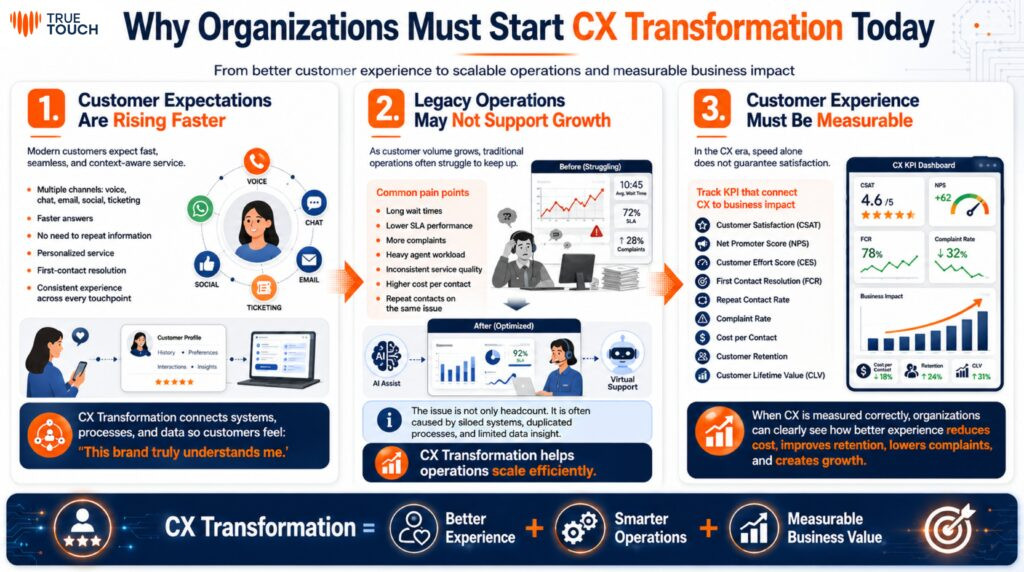
If an organization still works in silos, for example, the Contact Center uses one set of data, Sales uses another, and the Back Office uses yet another system, customers will immediately sense that “the experience is disconnected.”
CX Transformation therefore plays a crucial role in connecting systems, processes, and data together to create an experience in which customers feel that “the brand truly understands me.”
As the number of customers increases, the Contact Volume rises accordingly, whether through inbound calls, chat, email, social media, or tickets from various systems.
Based on experience in managing Contact Centers and Customer Experience for large organizations, we have found that these problems do not stem from “insufficient staff” alone, but from redundant processes, disconnected systems, and a lack of Data Insight for decision-making.
CX Transformation therefore plays a role in helping organizations reshape their operations to be ready to scale for growth efficiently.
But in the era of CX Transformation, measurement must look deeper than before, because “answering quickly” does not mean “the customer is satisfied.”
When an organization measures correctly, it can clearly answer how improving the Customer Experience affects the business, for example, reducing costs, increasing Retention, lowering complaints, or boosting the chance of repeat sales.
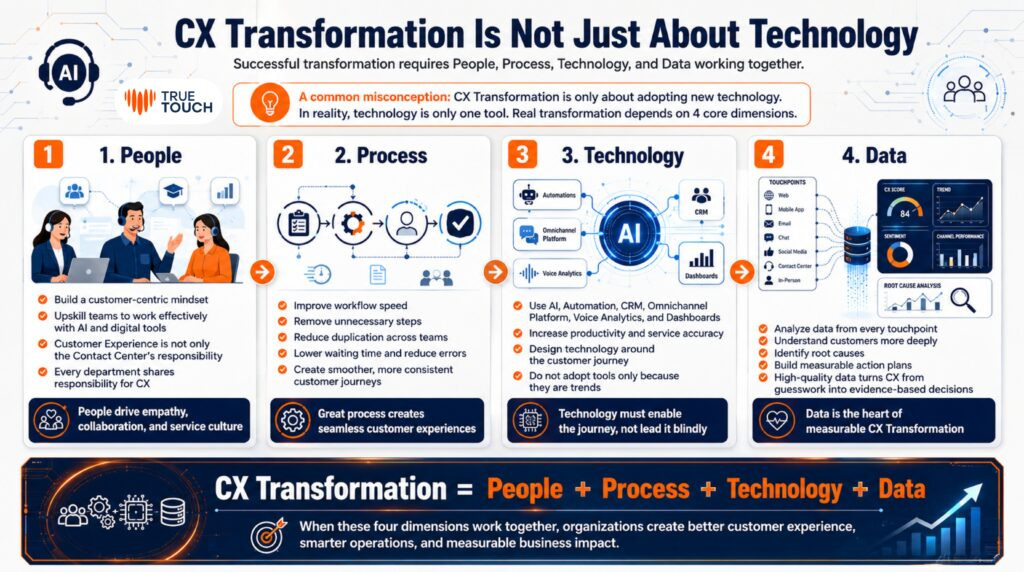
In reality, Technology is only one of the tools. A successful Transformation must be made up of four core dimensions.
Develop your team's skills so they adopt a Customer-Centric Mindset and can work effectively alongside AI or Digital Tools.
Teams must understand that Customer Experience is not the responsibility of the Contact Center alone, but a shared responsibility of every department.
A good Process helps reduce Waiting Time, reduce Errors, and gives customers a smoother and more seamless experience.
Use technologies such as AI, Automation, CRM, Omnichannel Platform, Voice Analytics, and Dashboards to increase Productivity and raise the accuracy of customer service.
Bring data from every Touchpoint together for analysis to understand customers, find the Root Cause, and create an Action Plan with truly measurable results.
Quality Data is the heart of what makes CX Transformation not guesswork, but decision-making based on real data.
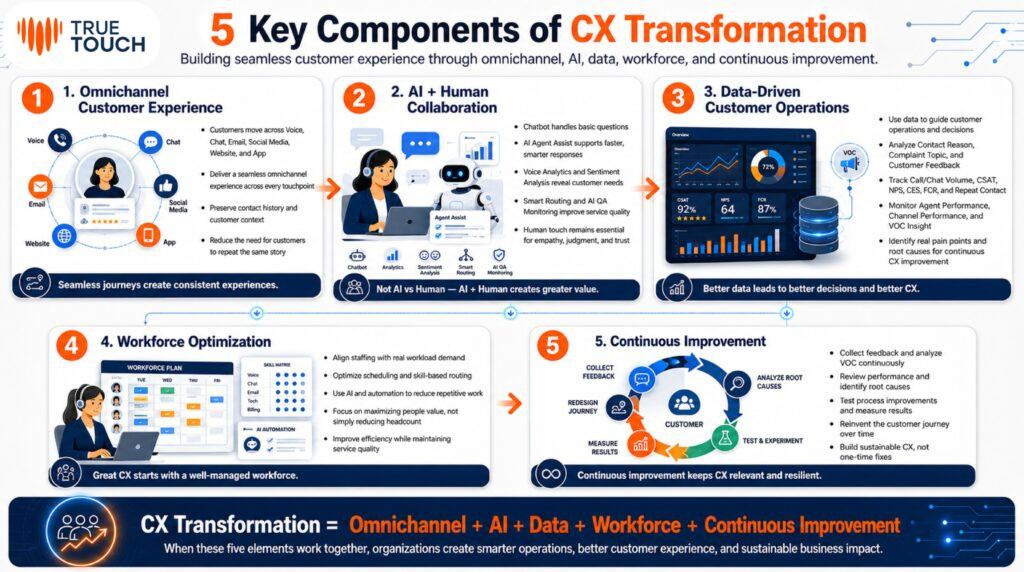
Customers no longer contact organizations through a single channel; they switch back and forth between Voice, Chat, Email, Social Media, Website, and Application.
CX Transformation therefore must enable an organization to connect every channel seamlessly (Seamless Omnichannel) so that customers receive a continuous experience no matter which channel they start from.
A good Omnichannel should help an organization see a customer's contact history, understand context, and reduce the need for customers to repeat the same story.
But the Human Touch remains very important, especially in cases that require understanding, emotion, judgment, and building trust.
Therefore, the right approach is not AI vs Human, but AI + Human Collaboration, so that AI helps reduce repetitive work and lets the team focus on work that creates greater value.
When Data is used systematically, an organization can see customers' true Pain Points, resolve problems down to the Root Cause, and continuously improve the Customer Experience.
Workforce Optimization helps an organization plan its workforce in line with actual workload, schedule shifts appropriately, use Skill-Based Routing, and apply AI or Automation to reduce repetitive work.
Continuous Improvement helps an organization develop its Customer Experience sustainably, rather than just fixing problems on an ad hoc basis.
The Contact Center is one of the most important Touchpoints of the Customer Experience, because it is the point where customers contact the organization directly when they have questions, problems, or need help.
CX Transformation helps the Contact Center evolve from a “call-answering center” into a “Customer Experience Hub” that can create greater value for the business.
True Touch has more than 20 years of experience managing Contact Centers and Customer Experience Solutions for both public and private sector organizations in Thailand.
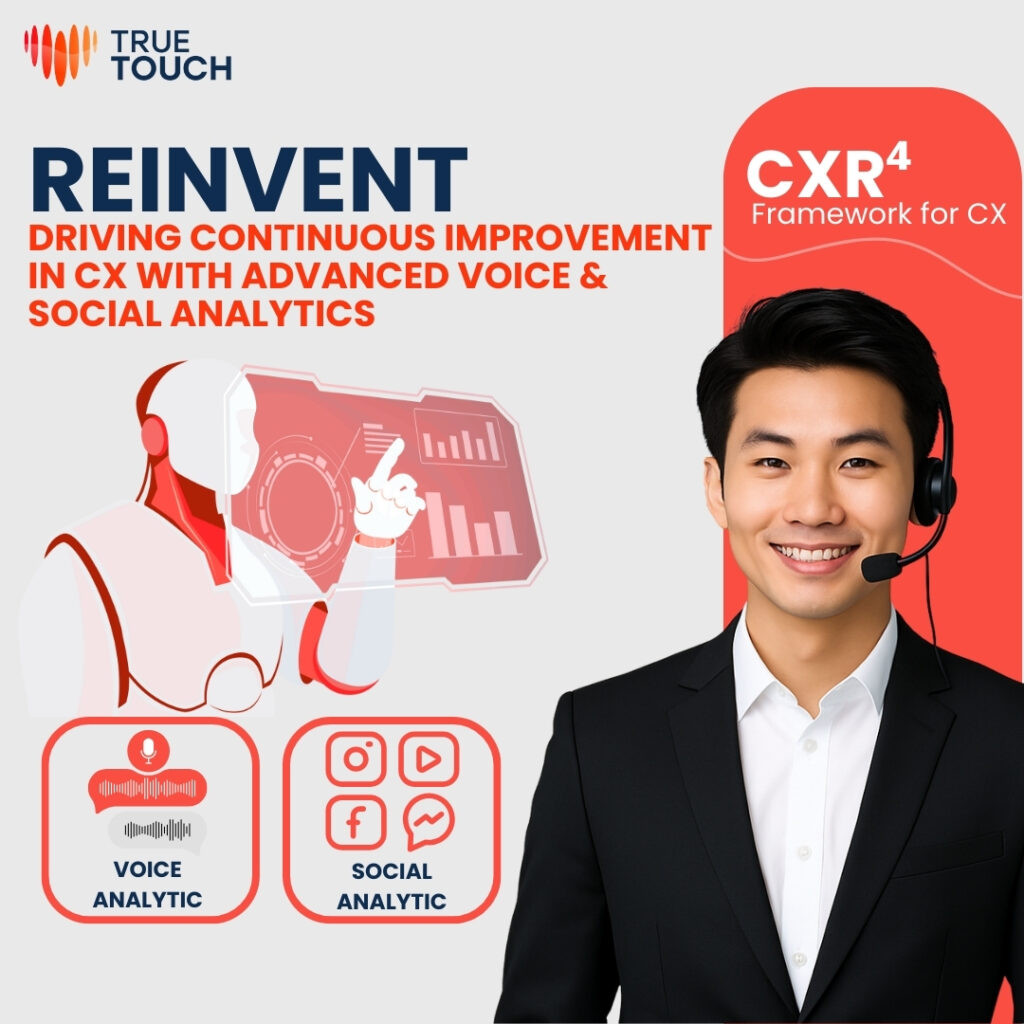
With the True Touch Total CX Solutions concept and the CXR4 Framework, True Touch helps organizations elevate their Customer Experience through four key dimensions.
This approach helps an organization connect People, Process, Technology, and Data together to create a better, truly measurable Customer Experience.


Organizations that start reshaping their operations today will be better prepared to scale their business, meet customer expectations, and compete in a constantly changing market.
Rather, they are the organizations that can create the best Customer Experience and reshape their operations to serve customers continuously.
Because when an organization can connect People, Process, Technology, and Data together, Customer Experience will no longer be just a service function but will become a truly measurable Business Value.
🚀Start CX Transformation with True Touch
Click here to contact us for a free planTrue Touch is ready to support your organization with more than 20 years of experience in Contact Center and Customer Experience Solutions.
A1: CX Transformation is the transformation of work processes, technology, people, and data to elevate the Customer Experience at every Touchpoint so that it is better and truly measurable.
A2: Digital Transformation focuses on adopting technology to improve work processes, whereas CX Transformation focuses directly on elevating the customer experience, using technology as one of its key tools.
A3: Because customer expectations are changing faster. If operations still work the old way, an organization may be unable to support growth, maintain service quality, or compete in the market effectively.
A4: AI helps increase speed, accuracy, and Productivity, for example, Chatbots, AI Agent Assist, Voice Analytics, Sentiment Analysis, and Smart Routing, but it must still work together with Human Agents to preserve Empathy and service quality.
A5: The Contact Center is one of the most important Touchpoints of the Customer Experience and a source of Voice of Customer data that helps an organization understand customers, uncover Insight, and continuously improve its services.