A key strategy for CX transformation & operational excellence

In an era where the customer experience has become a key measure of business growth, many organizations are running into the same challenge:
“How do we make the Contact Center work more efficiently without lowering the quality of customer service?”
Because in reality, running a Contact Center is not merely a matter of having enough agents; the team has to answer both sides at once:
- Efficient: working fast, using resources well, cutting unnecessary cost
- Quality: maintaining the service standard, creating satisfaction and giving customers a good experience
This is why workforce optimization has become one of the essentials of CX transformation and operational excellence in the modern Contact Center
What is workforce optimization?
Workforce optimization is the management of people, working processes, technology and data so that the Contact Center team can work at maximum efficiency while maintaining the quality of customer service at every touchpoint
Put simply, workforce optimization is not merely scheduling shifts or cutting headcount; it is about answering the important questions:
- How many people are needed at each time of day?
- What skills should agents have?
- Which channel carries the highest workload?
- What kind of work should be automated?
- Which KPIs genuinely reflect quality?
- How do you reduce cost without affecting the customer experience?
Managed well, the Contact Center is no longer merely a “call answering centre” but becomes an important hub for creating customer experience and business value for the organization
Why does workforce optimization matter to a Contact Center?
Many organizations with large contact centres hit similar pain points, such as
- Call or chat volume rising at certain times
- Not enough agents at peak hour
- Too many people at other times
- Fluctuating service level
- Inconsistent quality of answers to customers
- High agent turnover
- Operating cost rising without CX results improving to match
From the experience of businesses running Contact Center and customer experience operations, these problems usually do not come from “not enough people” alone, but from the lack of a workforce management system connected to data, process, technology and a quality framework
Workforce optimization is therefore an important tool that lets an organization manage its team more accurately, cut waste and raise the customer experience at the same time
Workforce optimization is not about cutting people; it is about getting the most value from them
One misunderstanding many organizations have is thinking workforce optimization means reducing headcount
In reality this approach does not start from “how do we cut people?” but from
“how do we make people, technology and working processes work together as well as possible?”
Because Contact Center work includes work that should be done by people and work that should be done by AI or automation
For example
AI and automation suit:
- Repetitive questions
- Retrieving basic information
- Screening requests
- Prioritising cases
- Summarising conversations
- Initial quality checking
Human agents suit:
- Complaint handling
- Complex cases
- Negotiation
- Advising
- Looking after emotionally sensitive customers
- Building the customer's confidence
Good workforce optimization therefore means designing things so that AI reduces the repetitive load and agents can focus on work that creates more value
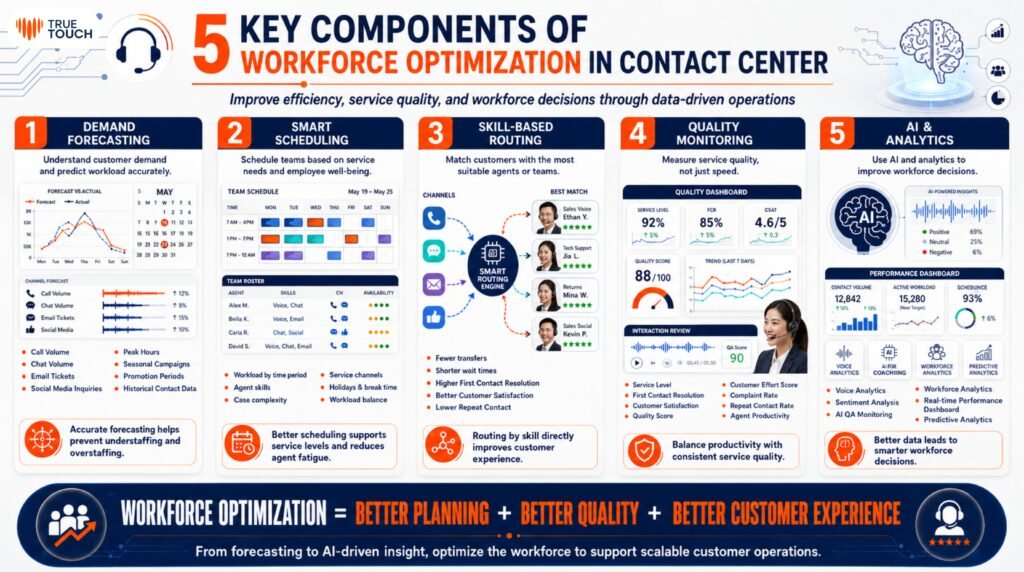
The 5 key components of workforce optimization in a Contact Center
1. Demand Forecasting: forecast the workload accurately
Managing a Contact Center team well starts with understanding customer demand
An organization should analyse data such as:
- Call volume
- Chat volume
- Email tickets
- Social media enquiries
- Peak hour
- Seasonal campaigns
- Promotion periods
- Historical contact data
in order to forecast workload in advance and arrange the workforce to fit real demand
With accurate forecasting, an organization can reduce the problem of too few agents at important times and reduce the cost of having more workforce than it needs
2. Smart Scheduling: schedule the team to answer both service level and employees' quality of life
Scheduling is not merely putting names into shifts
It has to take into account:
- Workload at each time of day
- Agents' skills
- The complexity of the work
- The channels that need serving
- Days off
- Break time
- Workload balance
Good smart scheduling helps the Contact Center maintain its service level continuously and reduces employee fatigue, which directly affects the quality of customer service
Because if agents are too tired, the quality of their communication, their patience and their empathy fall with it
3. Skill-Based Routing: send the customer to the right team
Every customer has a different problem. Some cases are general questions, some are technical, some are complaints or cases needing specific expertise
Skill-based routing therefore helps the customer be looked after by the most suitable agent or team
The results are:
- Fewer transfers
- Less waiting
- Higher first contact resolution
- Higher customer satisfaction
- Fewer repeat contacts
This is where workforce optimization connects directly to the customer experience
4. Quality Monitoring: measure quality, not merely speed
In the past a Contact Center tended to be measured on numbers such as AHT or the number of calls answered
But in the age of CX transformation, measurement has to look deeper
An organization should measure:
- Service level
- First contact resolution
- Customer satisfaction
- Quality score
- Customer effort score
- Complaint rate
- Repeat contact rate
- Agent productivity
Because answering quickly does not always mean the customer is satisfied
Good workforce optimization has to balance productivity and service quality, so the team works faster while keeping the customer experience consistent
5. AI & Analytics: use data to manage the team more accurately
AI and analytics are clearly changing how contact centres are run
Examples of use include:
- Voice analytics analysing conversations
- Sentiment analysis reading how the customer feels
- AI QA monitoring checking service quality
- Workforce analytics analysing productivity
- Dashboards tracking performance in real time
- Predictive analytics forecasting contact volume
With accurate data, an organization can decide more effectively — when to add people, what agents should be trained in, or which process should be improved
Workforce optimization and CX transformation
Workforce optimization is one of the foundations of CX transformation
Because a good customer experience does not come from the frontline alone; it comes from designing the whole operation so that it works in step
If an organization wants to raise CX sustainably, it has to connect workforce optimization to:
- The customer journey
- Operational excellence
- AI + human collaboration
- Voice of Customer
- Quality assurance
- Data-driven operations
When all the components work together, the Contact Center can genuinely change from a cost centre into a business value centre
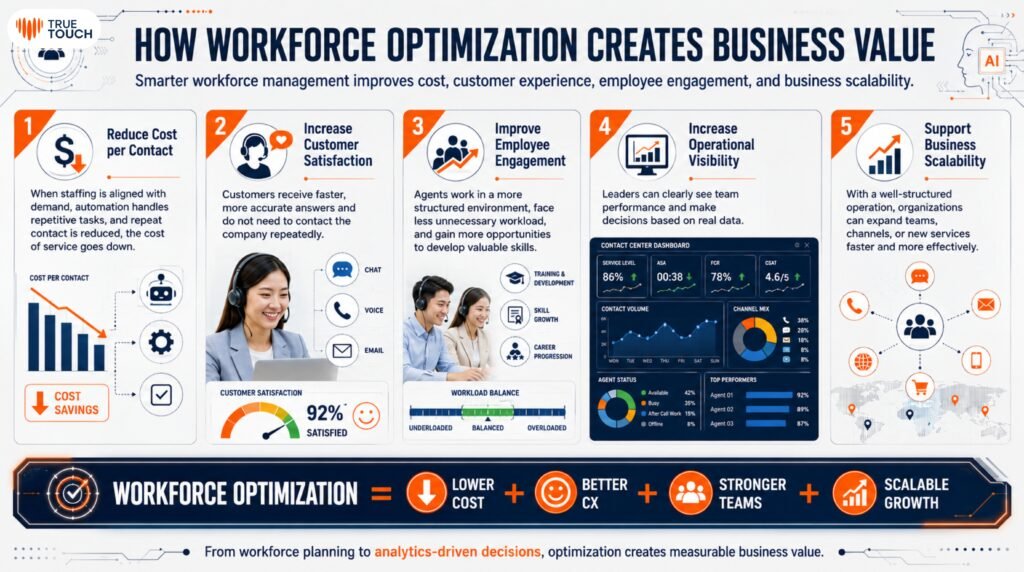
How does workforce optimization create business value?
Managing the workforce well does not affect only the Contact Center team; it affects the business as a whole, for example
Lower cost per contact
With the right people in the right place, automation on repetitive work and fewer repeat contacts, the cost of serving falls
Higher customer satisfaction
Customers get answers faster and more accurately, and do not have to get in touch again and again
Higher employee engagement
Agents work more systematically, carry less unnecessary load and have more opportunity to develop valuable skills
Greater operational visibility
Executives see the team's performance clearly and can decide from real data
Support for scaling the business
With a systematic operation, the organization can expand teams, channels or new services faster
True Touch and the workforce optimization approach
True Touch has more than 20 years of experience running Contact Center and customer experience solutions for organizations in both the public and private sectors in Thailand
Through the True Touch Total CX Solutions approach and the CXR4 Framework, which helps organizations raise the customer experience across 4 important dimensions:
- Reach: connecting with customers on every channel through an omnichannel Contact Center
- Reassure: building confidence with AI + human expertise
- Resolve: resolving problems quickly, accurately and to a standard
- Reinvent: developing the customer experience continuously with voice analytics, AI and social analytics
Within this approach, workforce optimization is the key mechanism that lets an organization run its team efficiently while maintaining service quality at every touchpoint


How an organization can start workforce optimization
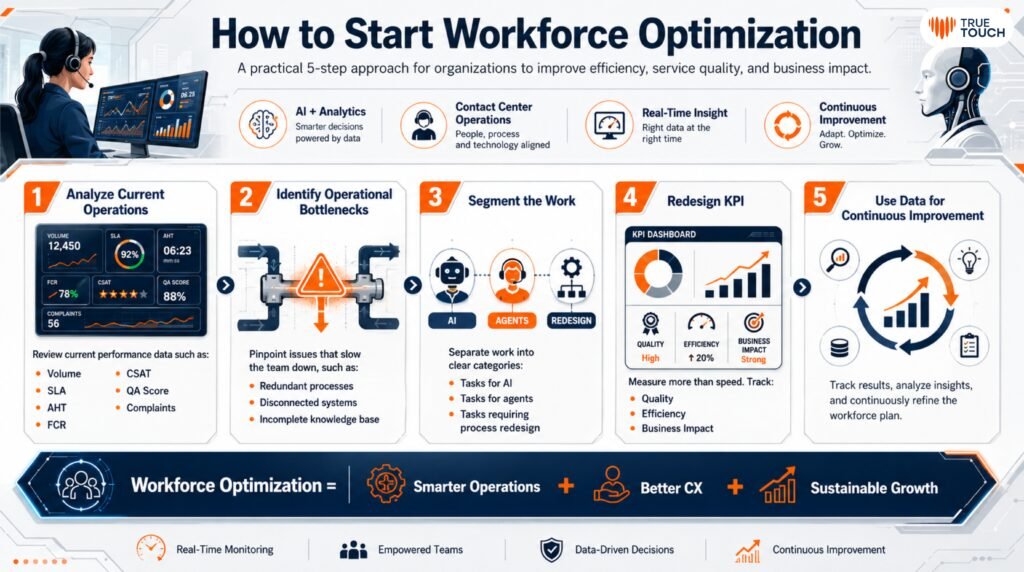
An organization wanting to start workforce optimization can begin with 5 main steps
1. Analyse the current operation
Look at current data such as volume, SLA, AHT, FCR, CSAT, QA score and complaints
2. Find the operational bottleneck
Identify what slows the team down — duplicated processes, systems that are not connected, or a knowledge base that is not ready
3. Categorise the work
Separate the work AI should do, the work agents should do, and the work whose process should be redesigned
4. Design new KPIs
Measure not only speed but quality, efficiency and business impact
5. Use data to keep improving
Track results, analyse insight and adjust the workforce plan regularly
In summary: workforce optimization is the key to the modern Contact Center
In 2026 the successful Contact Center is not the team with the most people, but the team that manages people, technology and data best
Workforce optimization is therefore at the heart of building a Contact Center that is both efficient and high quality
Because an organization that manages its workforce well can:
- Reduce cost
- Increase productivity
- Raise the customer experience
- Increase employee engagement
- and support the growth of the business sustainably
🚀 Raise your workforce optimization with True Touch
Click here to contact us for a free plan If your organization is looking for a way to:
- Run the Contact Center team more efficiently
- Reduce cost per contact without affecting quality
- Use AI and analytics to raise the operation
- Increase customer satisfaction and first contact resolution
- Get the Contact Center ready to support business scale
True Touch is ready to support your organization with more than 20 years of experience in Contact Center and customer experience solutions
to help your organization
“Optimize Workforce, Elevate Experience, Drive Business Growth”
📩 Contact us for a consultation or a demo at
📩 Contact us today to turn every customer voice into sustainable growth.
❓FAQ
Q1: What is workforce optimization?
A1: Workforce optimization is the management of people, working processes, technology and data so that the Contact Center team works efficiently while maintaining the quality of customer service
Q2: How does workforce optimization differ from workforce management?
A2: Workforce management tends to focus on scheduling and headcount, whereas workforce optimization takes a broader view, bringing quality, productivity, technology and business impact together
Q3: How does workforce optimization reduce cost?
A3: It reduces cost by putting the right people in the right place, cutting duplicated work, using automation and reducing repeat contacts from customers
Q4: What role does AI play in workforce optimization?
A4: AI helps analyse data, forecast workload, check service quality and help agents work faster and more accurately
Q5: Why does workforce optimization matter to the customer experience?
A5: Because managing the team well means customers get a service that is faster, more accurate and consistent in quality across every channel