
Why Modern Businesses Need Technology to Elevate Customer Operations
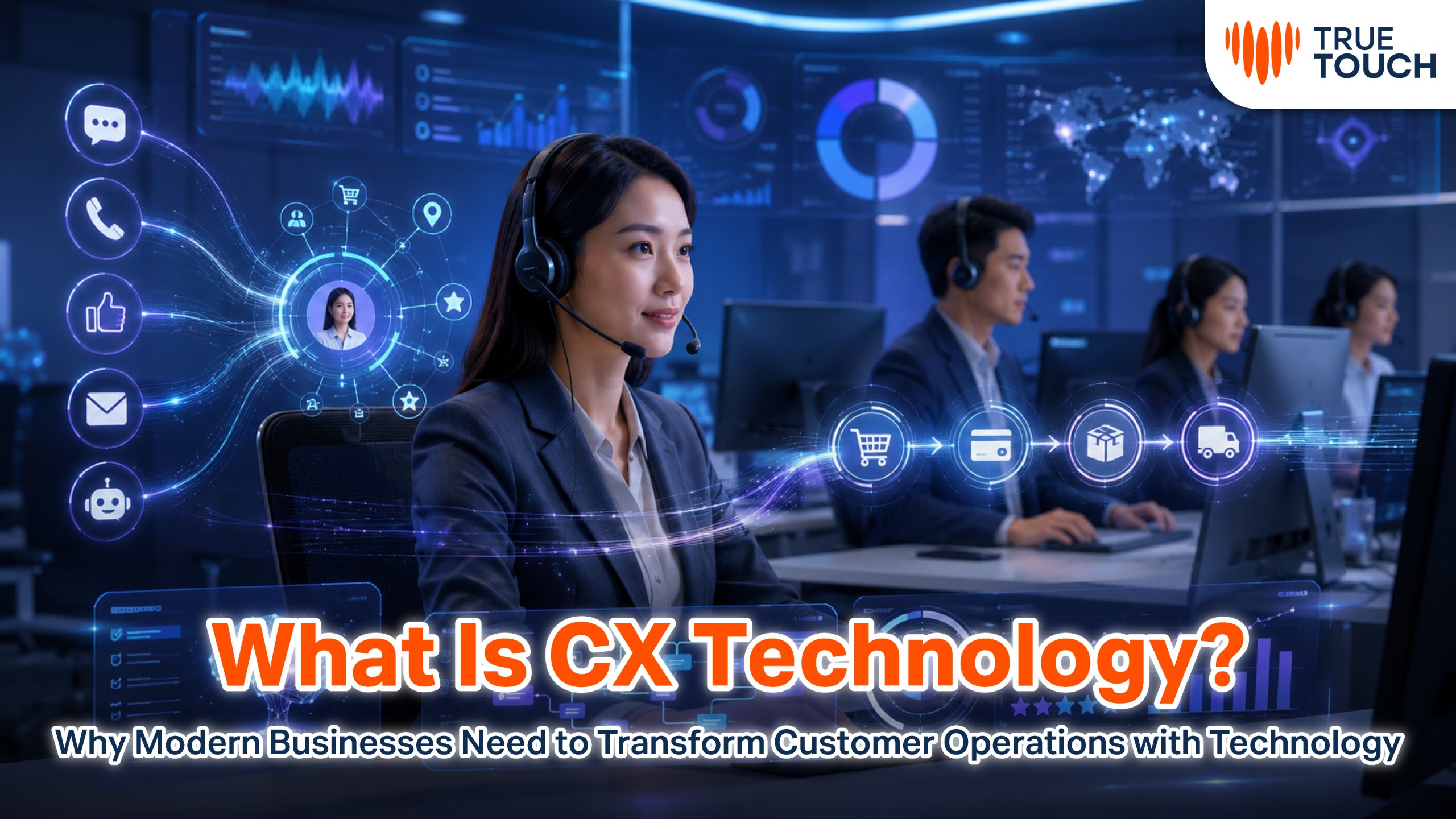
Customer service today no longer happens through a single channel. Customers may begin their journey on Social Media, continue through Chat, call a Contact Center, place an order, make a payment, and return later when they need further assistance.
The challenge is no longer simply “How quickly can we respond to customers?” but rather how effectively an organization can connect data, processes, and service quality across the entire Customer Journey.
This is where CX Technology plays an important role. It helps organizations manage Customer Experience and Customer Operations more effectively — from Customer Interaction Management and connected workflows to the use of Data and AI for service analysis and continuous improvement.
Based on True Touch’s more than 20 years of experience in Contact Center and Customer Experience, we have found that many Customer Operations challenges are not caused by people alone. They often result from disconnected data and systems, multi-step processes, and limited visibility into operational performance.
Therefore, good Technology should not simply “add more tools.” It should make Operations easier to manage, more connected, and better equipped to use data for continuous Customer Experience improvement.
CX Technology can be simply described as a set of technologies that helps organizations better manage every customer Touchpoint and the processes surrounding them.
It is not limited to CRM, Chatbots, or Contact Center Platforms, but may also include:
The goal is therefore not to have the most Technology, but to select Technology that solves real Customer Operations pain points.
According to Salesforce, 82% of Service Professionals say customer expectations are higher than they used to be. At the same time, Service employees spend less than half of their working time directly serving customers because a significant amount of time is still spent on administration and other internal tasks.
This highlights an important point: improving Customer Experience requires organizations to consider Customer + Agent + Process + Technology together.
When customers contact an organization through multiple channels but their information is stored across different systems, Agents may need to switch between screens, search for previous interaction history, or ask customers to repeat information.
The result is longer Response Time, higher Customer Effort, an inconsistent customer experience, and limited visibility across the Customer Journey.
One approach is to use CX Technology to bring Customer Information, Conversations, and Case Management into a Centralized Workspace, allowing Agents to understand customer context and continue the interaction more efficiently.
Salesforce reports that 82% of high-performing Service Organizations use the same CRM Platform across Service, Sales, and Marketing, highlighting the importance of a connected Data Foundation.
Customer Experience does not end when an Agent successfully receives a request.
In many businesses, a customer request must continue through several operational steps, such as:
Order → Payment → Branch → Fulfillment → Delivery
If each step operates in a separate system, organizations may face data re-entry, missed handoffs, delays, or an inability to track status in real time.
CX Technology should therefore do more than manage Customer Interactions. It should be able to turn Customer Requests into connected Operational Actions.
When Front Office and Back-end Operations operate within a connected workflow, organizations can reduce friction for both customers and employees at the same time
Another major Contact Center challenge is Quality Assurance, or QA.
Manual QA requires significant time, which means many organizations can review only a portion of customer Conversations. When the sample size is small, problematic or high-risk cases may remain undetected.
McKinsey notes that traditional Contact Center QA processes that rely heavily on small Conversation samples can be limited in coverage and may also be affected by Human Bias.
Introducing AI and Automation creates an opportunity to analyze a broader range of Conversations and detect patterns, issues, and quality risks more quickly.
As a result, the role of QA can evolve from simply asking “What happened?” to understanding “Why did it happen, and how should we improve it?”
Insights generated by AI can then support Analysis, Coaching, and Continuous Improvement, helping organizations improve Agents, Processes, and Customer Experience over time.
At True Touch, we believe Technology should not be designed separately from Operations.
Based on our real-world experience managing Contact Centers and Customer Operations, we see Technology through three key approaches:
Connect Customer Data, Conversations, and Service Management so teams can understand customer context and manage interactions more seamlessly.
Solution: TOUCHCONNEXTE
Turn Customer Requests into structured operational workflows across Order, Payment, Branch, and Delivery.
Solution: TOUCHDELI
Transform Customer Interaction Data into Quality Insights to detect issues and continuously improve Service Quality.
Solution: QA Automation
This approach can be summarized as:
Connect. Fulfill. Improve.
Because great Customer Experience does not come from a single Touchpoint. It comes from connecting Customer Interaction, Operations, and Quality across the entire Journey.
IBM explains that Contact Center Automation can reduce Routine and Repetitive Tasks, allowing Human Agents to spend more time handling complex customer needs. This is an example of using Technology to strengthen Operations rather than simply replace people.
Organizations do not need to replace every existing system at once.
A practical starting point is to ask three simple questions:
1. CONNECT — Are Our Customer Interactions Fragmented?
If Agents need to open multiple systems or cannot see Customer History in one place, the organization may need to begin by connecting Data and Service Management.
2. FULFILL — Are Back-end Processes Connected After a Customer Request Is Received?
If teams still rely on Manual Handoffs, data re-entry, or cannot see the current status of a request, it may be time to consider connected Workflow and Fulfillment.
3. IMPROVE — Do We Have Enough Visibility into Service Quality?
If QA teams can review only a small sample of interactions, AI and Automation may help increase Quality Visibility.
The key principle is to start with the Business Problem before selecting the Technology.
Technology creates meaningful impact when it improves both Customer Experience and Operational Performance at the same time.
As Customer Expectations continue to rise, organizations should no longer view CX Technology as simply another IT tool. It should be considered part of how Customer Operations are designed.
At True Touch, we combine our experience in Contact Center Operations and Customer Experience with Technology to create Solutions designed around real operational challenges.
From CONNECTING Customer Interactions
to FULFILLING Customer Requests
and IMPROVING Service Quality with AI and Data
all toward one shared goal:
Smarter Technology. Better Customer Operations.
Discover the right Solution for your Business Challenge — whether you need to connect Customer Interactions, streamline Order & Fulfillment, or use AI to elevate Quality Assurance.

CRM is one type of Technology used to manage customer data and customer relationships.
CX Technology has a broader scope, covering Customer Interaction, Service Management, Workflow, Fulfillment, Analytics, Automation, and AI to support End-to-End Customer Experience Management.
It goes beyond storing customer information by helping different processes and Touchpoints work together more effectively.
CX Technology is suitable for organizations with Customer Service, Contact Center, or Customer Operations functions, particularly businesses that manage interactions across multiple channels, rely on multiple handoff processes, or want greater visibility and control over service quality.
No. Organizations can begin with the pain point that has the highest business impact and integrate the appropriate Solution with existing systems based on a suitable Integration Scope.
This approach helps reduce implementation complexity while making it easier to measure the Business Impact of Technology.