

Why Is Connecting Orders to Delivery Important for Modern Businesses?

Receiving an Order from a customer is not the end of the Customer Journey. It is the beginning of several operational processes that follow.
After a customer places an order, the business may need to continue with several steps — from verifying information, confirming payment, sending the Order to the appropriate branch, preparing the product, coordinating delivery, to tracking the status until the product reaches the customer.
This entire process is called Order Fulfillment.
The challenge arises when each step operates in a different system or still relies on Manual processes, such as copying information, forwarding details through Chat, calling a branch to notify them, or entering the same information repeatedly.
Based on True Touch’s more than 20 years of experience in Contact Center Management and Customer Operations, we have found that a good Customer Experience does not depend solely on how quickly a call is answered or an Order is received. It also depends on how accurately and seamlessly a customer request can be transferred into Operations.
This is why Order Fulfillment is becoming an increasingly important part of modern Customer Operations.
Order Fulfillment is the process from the moment a business receives an order from a customer through to the successful processing and delivery of the product or service.
For businesses that receive Orders through a Contact Center, Website, or digital channels, the process may include:
Order Received → Payment → Branch Processing → Delivery → Completed
In practice, however, each step may involve multiple systems and teams, such as:
Salesforce explains that today’s Order Lifecycle does not end at the “Buy” button. It also includes the Post-purchase Experience and product delivery, while Order Management plays an important role in connecting systems, processes, and data throughout the entire Order Lifecycle.
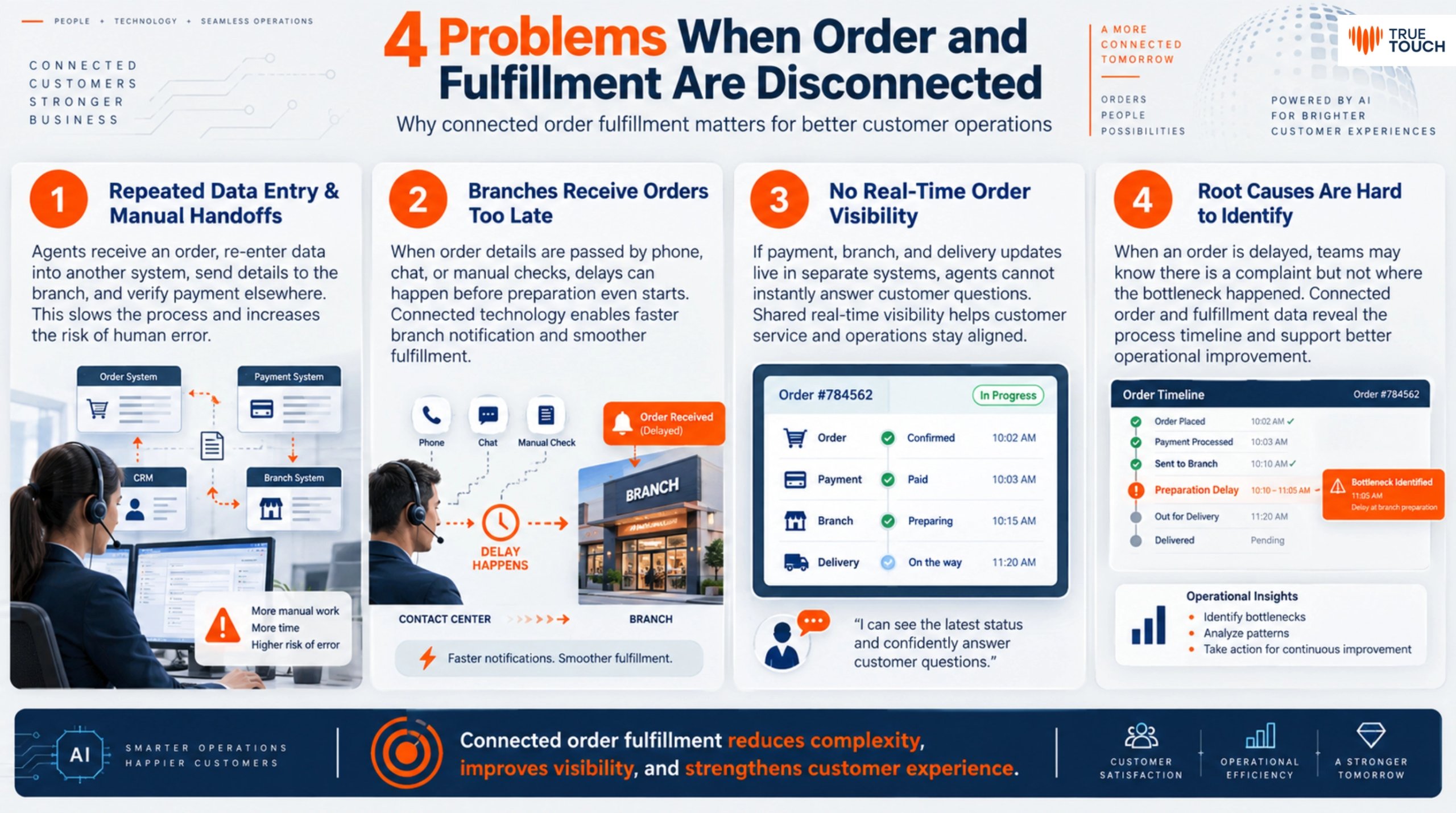
Consider a Contact Center that receives an Order from a customer. The Agent then needs to enter the information into another system, send the details to the branch, and verify Payment through another channel.
Every Re-key or Manual Handoff not only makes the Process take longer, but also increases the risk of Human Error, such as incorrect customer information, incorrect product details, or sending the Order to the wrong branch.
A connected Order Fulfillment system should therefore help information move together with the Workflow, reducing unnecessary data re-entry and repeated handoffs.
In businesses with multiple branches, the speed at which an Order is transferred from the Front Office to the branch directly affects service delivery time.
If the process still requires phone calls, messages, or Manual verification, delays may occur even before product preparation begins.
Technology can help ensure that Orders are systematically routed to the relevant branch or department, together with Notifications and the information required for the next step.
Oracle states that Order Management can be used to Orchestrate Fulfillment processes across multiple systems and help create a more continuous End-to-End Order Flow.
When a customer calls back and asks:
“Where is my order now?”
“Has the payment been completed?”
“Has the branch received the order?”
“Is the order out for delivery?”
The Agent should be able to answer based on information that is immediately visible.
However, if Payment, Branch, and Delivery information are separated across different systems, the Agent may need to call or message another team before responding to the customer.
Having Real-time Order Visibility allows both Customer Service and Operations teams to see the same status, reducing follow-up effort and making communication with customers clearer.
Salesforce views Speed, Transparency, and Simplicity throughout the Fulfillment process as part of the Post-purchase Customer Experience, rather than merely a Back-office Operations issue.
If an Order is delayed, what caused the problem?
Has the Payment not yet been Confirmed?
Was the Order not sent to the branch?
Did the branch take too long to prepare it?
Or is there an issue with Delivery?
When each Process is disconnected, the business may only know that “the customer has made a Complaint,” without knowing where the Bottleneck actually occurred.
Connecting Order and Fulfillment data helps organizations see the Process Timeline and use that information to analyze and improve Operations more accurately.
Effective Order Fulfillment should do more than simply store Orders. It should enable Customer Requests to be continuously transformed into Operational Actions.
From a Customer Operations perspective, there are at least four important elements.
Bring Order intake, Customer Profile, Product, Promotion, and the information required by Agents into a clear and structured Workflow.
Connect Payment Methods and Payment Status with the Order to reduce Manual verification and confirmation.
Once an Order is ready for processing, the system can send the relevant information to the appropriate branch or department more quickly.
Teams can track the Order from the moment it is received through to Delivery, allowing both Front Office and Operations teams to see the same information.
Salesforce states that integrating Order Data can help Service Agents access information such as Order History, Customer Records, Payment, and service information from a single point, helping to better connect Commerce with Customer Service.
Under the concept of True Touch CX Technology Solutions — Connect. Fulfill. Improve.
TOUCHDELI represents the FULFILL component and is designed to connect Ordering and Business Fulfillment processes from Order intake through to Operations.
An example Flow includes:
Order → Payment → Branch → Delivery
Its capabilities can include:
The key concept is not to introduce another Ordering System, but to enable Customer Service and Operations to work together within a more connected Flow.
Good Technology should begin with an understanding of the Current Process.
Organizations can start with five questions:
The answers to these questions can help identify where the Bottlenecks are and which areas should be addressed with Technology first.
McKinsey emphasizes the importance of viewing the Customer Journey End-to-End because the customer experience is created by a series of Interactions and Processes throughout the Journey, not by a single Touchpoint.
herefore, investment in Order Fulfillment should consider Customer Experience, Operational Efficiency, and the ability to Integrate with existing systems together.
If your business still relies on Manual Order handoffs, checks Payment across multiple systems, or cannot continuously track status from Order through to Delivery, it may be time to review whether your current Fulfillment Process is sufficiently connected.
Discover how TOUCHDELI can help connect Ordering, Payment, Branch, and Delivery into Connected Customer Operations.
For more information, please contact:
Tel: +66(0)2088-8999
Email: [email protected]
Website: https://www.truetouch.co.th/en
Order Management focuses on managing the Order Lifecycle from receiving the order, verifying information and status, to coordinating with relevant departments or systems.
Order Fulfillment, on the other hand, focuses on the process of executing the Order through to actual delivery.
The two areas are therefore closely related and should be designed to work together.
Order Fulfillment is suitable for businesses that receive Orders from multiple channels and have multiple branches or departments involved in fulfilling Orders.
It is particularly relevant for Food & Beverage, Delivery, Retail, or businesses that use a Contact Center as one of their channels for receiving Orders and providing customer service.
This depends on each organization’s Business Requirements and Architecture.
In general, integration may need to be considered with systems such as the Customer Database, Payment Gateway, Branch System, or Delivery Platform so that Order information and status can flow continuously across the process.
The Integration Scope should therefore be assessed before actual Implementation.