

From QA Sampling to AI-Powered Quality Intelligence
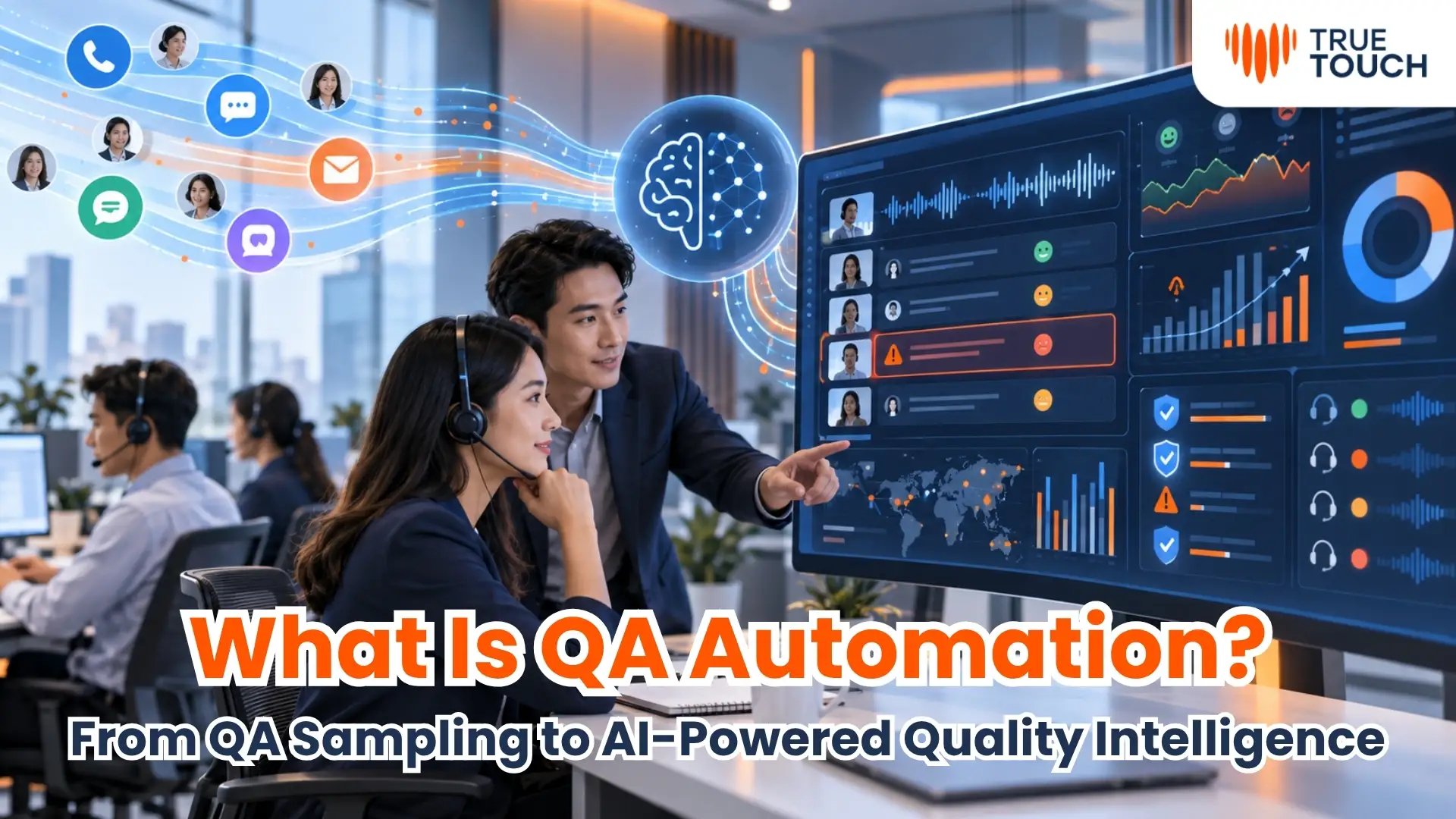
A Contact Center may handle hundreds or even tens of thousands of Conversations every day. However, a Quality Assurance (QA) team cannot manually review every Conversation.
As a result, many organizations rely on Sampling, selecting only a portion of Interactions to evaluate Agent service quality.
This approach remains important. However, as Interaction volumes and communication channels continue to grow, a key question arises:
“What might the organization be missing in the Conversations that are not selected for review?”
Based on True Touch’s more than 20 years of experience in Contact Center Management and Quality Assurance, we believe QA should do more than simply score Agents. It should help organizations identify problems, understand root causes, and turn information into meaningful service improvements.
This is one of the reasons QA Automation and AI are becoming increasingly important — helping QA evolve from “reviewing a sample” toward creating Quality Intelligence that provides broader visibility into overall service quality.
QA Automation is the use of Technology and AI to help review, analyze, and evaluate Customer Interactions based on the QA Criteria defined by an organization.
For example, AI can help determine whether an Agent:
Instead of requiring QA teams to listen to or read each Conversation individually, the system can help screen and analyze a larger volume of Interactions, identify Cases with important issues, and forward them to Human QA for deeper review and evaluation.
McKinsey notes that traditional Contact Center QA still relies heavily on Manual processes and small Conversation samples, which can create limitations in both Coverage and Human Bias. Generative AI, meanwhile, creates opportunities to perform quality reviews on a much broader scale.
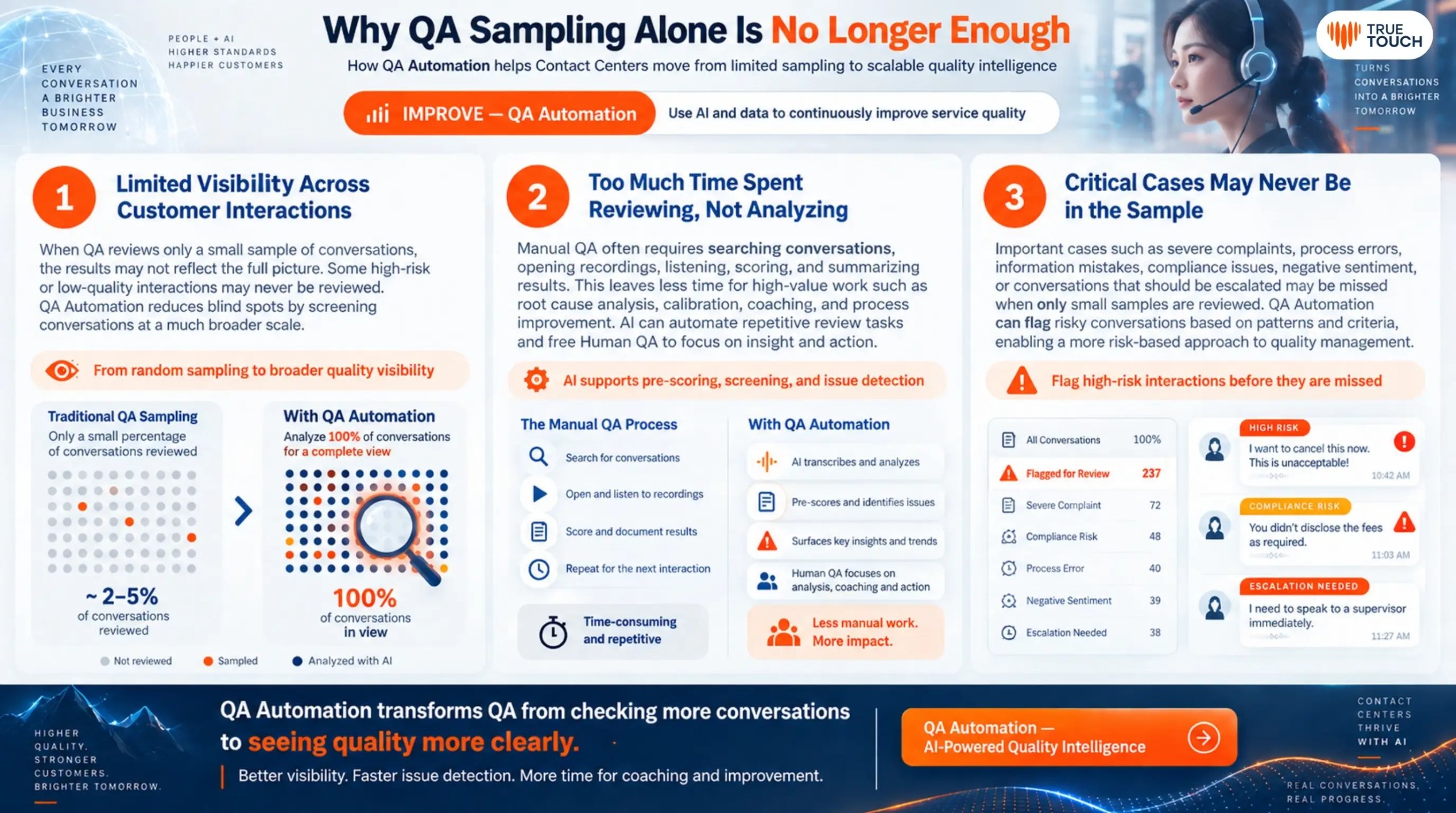
When QA teams review only selected Conversation Samples, what they see may not represent all Interactions that actually occur.
An Agent may receive a good score from a sampled Conversation while other problematic Cases remain unreviewed.
Genesys explains that Quality Management can help organizations move beyond Random Sampling to gain a deeper understanding of Customer Interactions and the Root Causes behind Agent behavior.
Therefore, the goal of Automation is not simply to “review more Conversations,” but to reduce the Blind Spots within Quality Management.
Manual QA typically involves multiple steps — searching for Conversations, opening Recordings, listening to interactions, completing Check Sheets, and summarizing scores.
When most of the team’s time is spent on these activities, there may be less time available for higher-impact work such as:
Root Cause Analysis, Calibration, Coaching, and Process Improvement
AI can support repetitive activities such as Pre-scoring, Interaction Screening, and Issue Detection, allowing Human QA teams to focus more on analysis and decisions that require deeper Expertise.
Genesys notes that AI can help Automate Review and Evaluation processes, enabling teams to identify Issues faster while reducing reliance on Random Sampling or Manual Assignment when selecting Conversations for review.
One of the risks of Sampling is that important Cases may never be selected for review, such as:
QA Automation can help screen Conversations at a broader scale and Flag Interactions that match specific Patterns or Criteria requiring further investigation.
This enables QA to move from waiting for problems to appear within a Sample toward a more Risk-based Quality Management approach.
Although AI can help review Conversations at a much larger Scale, this does not mean Human QA is no longer necessary.
In fact, Human QA becomes even more important in several areas.
How effectively AI performs depends on the Criteria that organizations define and use to guide the system.
Different businesses have different standards. For example, Financial Services may place greater emphasis on Compliance, while Customer Service operations may prioritize Empathy, Resolution, or Process Accuracy.
Organizations should regularly compare AI and Human QA results to ensure that Interpretation and Scoring remain aligned with the required standards.
Language, context, tone of voice, and customer situations may be too complex to evaluate using straightforward Criteria alone.
A Human-in-the-Loop approach should therefore be applied to Cases where AI has low Confidence, where risks are high, or where additional Context is required for decision-making.
NiCE emphasizes a similar principle, stating that when AI is used to evaluate Interactions, users should be able to understand the Criteria, Evidence, and reasoning behind the evaluation so that Human reviewers can confidently Review and Validate the results.
The true value of QA Automation should go beyond simply generating more “QA Scores.”
When organizations can analyze Conversations at a broader Scale, the data can be used to identify Patterns such as:
Individual Interaction data can therefore evolve into Quality Intelligence for Team Leaders, QA teams, and Management.
From this perspective, AI is not simply “reviewing instead of people.” It helps transform large volumes of Conversations into information that organizations can use to continuously improve Service Quality.
Under the concept of True Touch CX Technology Solutions — Connect. Fulfill. Improve.
QA Automation represents the IMPROVE component, combining AI with True Touch’s expertise in Contact Center Quality Assurance.
Our approach begins with QA Expertise before Technology, because the QA Check Sheet for each organization should not be based on the same standard Template.
QA Automation can therefore be designed around:
AI can then support Automated QA, Interaction Screening, Issue Detection, and Quality Analysis, while Human QA continues to perform Validation and Calibration.
From applying this approach across different types of operations, True Touch has found that Automation can help increase QA Coverage, reduce Manual QA workload, and improve the ability to identify Problem Cases.
However, actual results depend on factors such as Conversation Volume, Check Sheet design, Data Quality, AI Model, and Project Scope.
This distinction is important because effective QA Automation should deliver both Scale and Trust.
Organizations should not begin with only one question:
“What percentage of Conversations can AI review?”
Instead, they should start with four key considerations:
Answering these questions helps organizations use AI to solve real Quality Problems, rather than simply adding another Technology system into Operations.
If your Contact Center can currently review only a limited Sample of Interactions, or if your QA team spends most of its time on Manual Review, it may be time to consider how AI can increase Quality Visibility and help your organization gain more value from Customer Interaction Data.
Discover True Touch QA Automation, combining AI with Contact Center Quality Assurance experience to help transform QA from Sampling to Scalable Quality Intelligence.
For more information, please contact:
Tel: +66(0)2088-8999
Email: [email protected]
Website: https://www.truetouch.co.th/en
From a Technology perspective, an AI system can be designed to process Conversations at a broad scale, potentially up to 100%.
However, the actual Coverage that can be achieved depends on several factors, including Scope, Channel, Data Availability, Integration, Criteria, and the budget of each project.
Requirements should therefore be evaluated before Implementation.
NiCE notes that AI Quality Management can be used to evaluate up to 100% of Interactions and help reduce Blind Spots associated with Traditional Sampling.
Yes.
The role of Human QA shifts from spending most of its time on Manual Checking toward higher-value activities such as Calibration, Validation, Root Cause Analysis, Coaching, and improving QA Criteria.
These activities still require professional Expertise and contextual understanding.
In many cases, QA Automation can be designed to align with an organization’s existing Check Sheet.
However, it is important to first assess which Criteria can be clearly measured from Conversation Data and which Criteria still require Human Judgment and Context.
The Automated Criteria and Validation Process can then be designed accordingly.