
Service Excellence Framework: Raising the Contact Center from SLA to Business Value

Turning service work from “meeting the measures” into creating business value

Service Excellence Framework สำหรับยกระดับ Contact Center สู่ Business Value

In the past, many organizations measured the success of a Contact Center through operational measures such as SLA, Average Handle Time (AHT), call waiting time or the number of calls answered per day

Those numbers still matter, but in 2026 many organizations are finding that “meeting the SLA” does not always mean the customer experience is good

Because what customers remember is not merely how quickly the call was answered, but whether the organization understood their problem, whether it was resolved for good, and whether it left them more confident in the brand

This is why the modern organization has to look at the Contact Center through the Service Excellence Framework, to raise service work from meeting an SLA to creating business value that can genuinely be measured

What is the Service Excellence Framework?

The Service Excellence Framework is a way of thinking about managing and developing service quality systematically, connecting people, process, technology, data and customer experience end to end

The goal of this framework is not merely to make the service team “answer fast” or “close cases on time” but to raise the Contact Center so it can produce results of value to the business, such as

  • Higher customer satisfaction
  • Higher first contact resolution
  • Fewer repeat contacts
  • Fewer complaints
  • Lower cost per contact
  • Higher customer retention
  • Voice of Customer insight
  • Support for the growth of the business

Put simply, the Service Excellence Framework helps an organization see the Contact Center not merely as an “enquiry desk” but as “the hub for creating value from the customer experience”

Why the SLA alone is no longer enough

The SLA is a necessary measure, because it shows an organization the basic efficiency of its service — waiting time, response speed, or the level of service against the agreement

But the SLA has its limits, because it tends to measure “speed” rather than “the quality of the experience”

For example

  • The call is answered fast, but the problem is not solved
  • The case is closed quickly, but the customer has to get in touch again
  • The chatbot answers instantly, but not to the point
  • The agent follows the script fully, but the customer does not feel understood
  • The SLA is met, but complaints keep rising

From experience running Contact Center and customer experience operations for large organizations, the organizations that genuinely raise their service tend not to look at the SLA alone, but at the whole customer journey and business impact together

The Service Excellence Framework therefore helps an organization move from the question

“are we answering customers fast enough?”

to the more important question

“are we genuinely creating a good experience and creating business value?”

The core principles of the Service Excellence Framework

1. Customer-Centric Mindset: start from the customer's point of view

The heart of service excellence is designing the service from the customer's point of view, not from the point of view of the organization's internal systems alone

An organization should ask

  • What does the customer really want?
  • Where are the pain points?
  • Which point in the journey wastes the customer's time?
  • Why does the customer have to get in touch again?
  • What makes the customer lack confidence in the service?

Once an organization understands the customer's point of view, it can design better processes, scripts, channels and service journeys

2. Operational Excellence: make the service efficient and consistent

Service excellence cannot happen if the operation still works in a duplicated or disconnected way

An organization needs a clear system for managing operations, such as

  • A workflow that cuts unnecessary steps
  • An escalation process that is not complicated
  • A knowledge base that is up to date and easy to use
  • Workforce planning that matches the workload
  • A quality assurance framework that measures both accuracy and the quality of communication

Operational excellence lets the service team work faster, reduces errors and creates a consistent service standard across every channel

3. AI + Human Collaboration: use technology to strengthen people

In the age of AI-driven customer experience, technology plays an important part in raising the Contact Center

For example

  • An AI chatbot answering basic questions
  • AI Agent Assist suggesting answers to agents
  • Voice analytics analysing conversations
  • Sentiment analysis reading how the customer feels
  • Smart routing sending cases to the right team
  • AI QA monitoring checking service quality

But good service excellence does not mean using AI to replace people entirely, because many kinds of service work require empathy, judgement and the human touch

particularly in cases involving complaints, complex problems, or situations where the customer needs reassurance

The right approach is therefore AI + human collaboration: let AI cut repetitive work, add speed and analyse the data, while human agents focus on work that requires understanding and judgement

4. Data-Driven Service Management: manage the service on real data

Service excellence has to be measurable, and good measurement takes data

An organization should analyse data from several touchpoints, such as

  • Call / chat / email volume
  • Contact reason
  • First contact resolution
  • Repeat contact rate
  • CSAT / NPS / CES
  • Complaint topics
  • Agent quality score
  • Customer sentiment
  • Voice of Customer insight

This data shows an organization where the real problem lies, what the customer is getting stuck on, and how the service journey should be improved

Used systematically, the Contact Center is no longer merely the team that takes customer enquiries; it becomes an important source of insight for the business

5. Continuous Improvement: keep improving the service

Service excellence is not a one-off project but a process of continuous development

An organization should have an improvement cycle, such as

  1. Collect: gather data from every touchpoint
  2. Analyze: analyse the pain points and root causes
  3. Prioritize: choose the issues that affect customers and the business most
  4. Improve: adjust the process, script, training or technology
  5. Measure: measure the result after the change
  6. Reinvent: keep developing the customer experience

Done continuously, an organization can maintain service quality over the long term and keep up with customer expectations, which change all the time
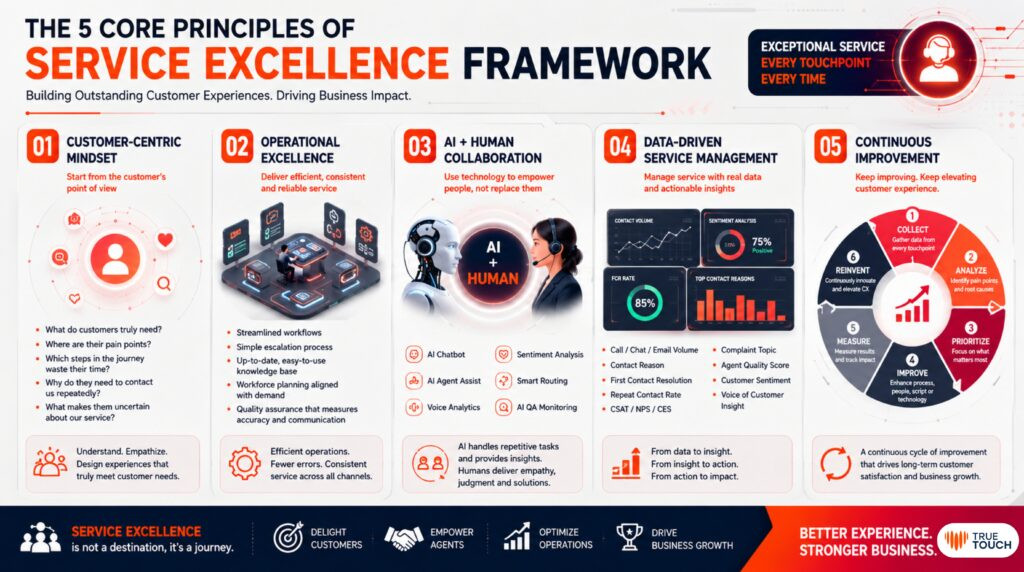
5 Core Priciples of Service Excellence Framework สำหรับยกระดับ Contact Center สู่ Business Value

The KPIs to measure in a Service Excellence Framework

Raising the Contact Center from SLA to business value means measuring more than speed-based KPIs

The measures to consider include

Operational KPI

  • SLA
  • Average Handle Time
  • Waiting Time
  • Abandon Rate
  • Case Resolution Time

Customer Experience KPI

  • Customer Satisfaction
  • Net Promoter Score
  • Customer Effort Score
  • First Contact Resolution
  • Repeat Contact Rate

Quality KPI

  • Quality Score
  • Compliance Score
  • Script Accuracy
  • Communication Quality
  • Complaint Handling Quality

Business KPI

  • Cost per Contact
  • Customer Retention
  • Complaint Reduction
  • Revenue Opportunity
  • Customer Lifetime Value

Once these KPIs are connected, an organization can see the relationship between “service quality” and “business results” much more clearly

How does a Contact Center create business value?

The modern Contact Center is not merely a cost centre; it can create business value in several dimensions

1. Lower cost from repeat contacts

When the team resolves the problem the first time, customers do not have to get in touch again, so the cost of serving falls

2. Higher customer retention

A good experience keeps customers with the brand longer and reduces the chance of them moving to a competitor

3. Insight for the business

Data from the Contact Center reflects customers' pain points, problems with the product and opportunities to develop the service

4. Greater brand trust

When an organization serves quickly, accurately and with understanding, it builds confidence in the brand

5. Support for revenue opportunity

An agent who understands the customer and has the right information can recommend additional services or pass business opportunities on to the sales team appropriately
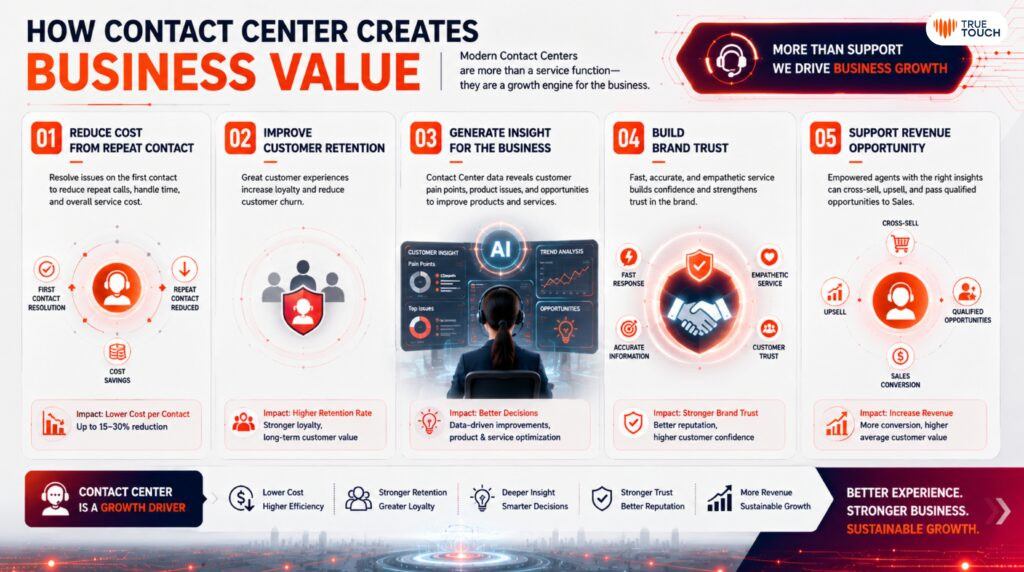
How Contact Center Creates Business Value สำหรับยกระดับ Contact Center สู่ Business Value

The Service Excellence Framework and True Touch's CXR4 Framework

True Touch uses the CXR4 Framework to raise the customer experience end to end, and it connects clearly to the Service Excellence Framework

Reach

Connecting with customers on every channel through an omnichannel Contact Center, to create a continuous experience at every touchpoint

Reassure

Building customer confidence with AI-powered automation together with the human expertise of a professional team

Resolve

Resolving problems quickly, accurately and to a standard, using data-driven insights, a QA framework and service standards

Reinvent

Developing the customer experience continuously with voice analytics, AI analytics and social analytics, to keep up with customer expectations

The CXR4 Framework means service excellence does not stop at serving to a standard, but goes on to create an experience that can be measured and kept improving

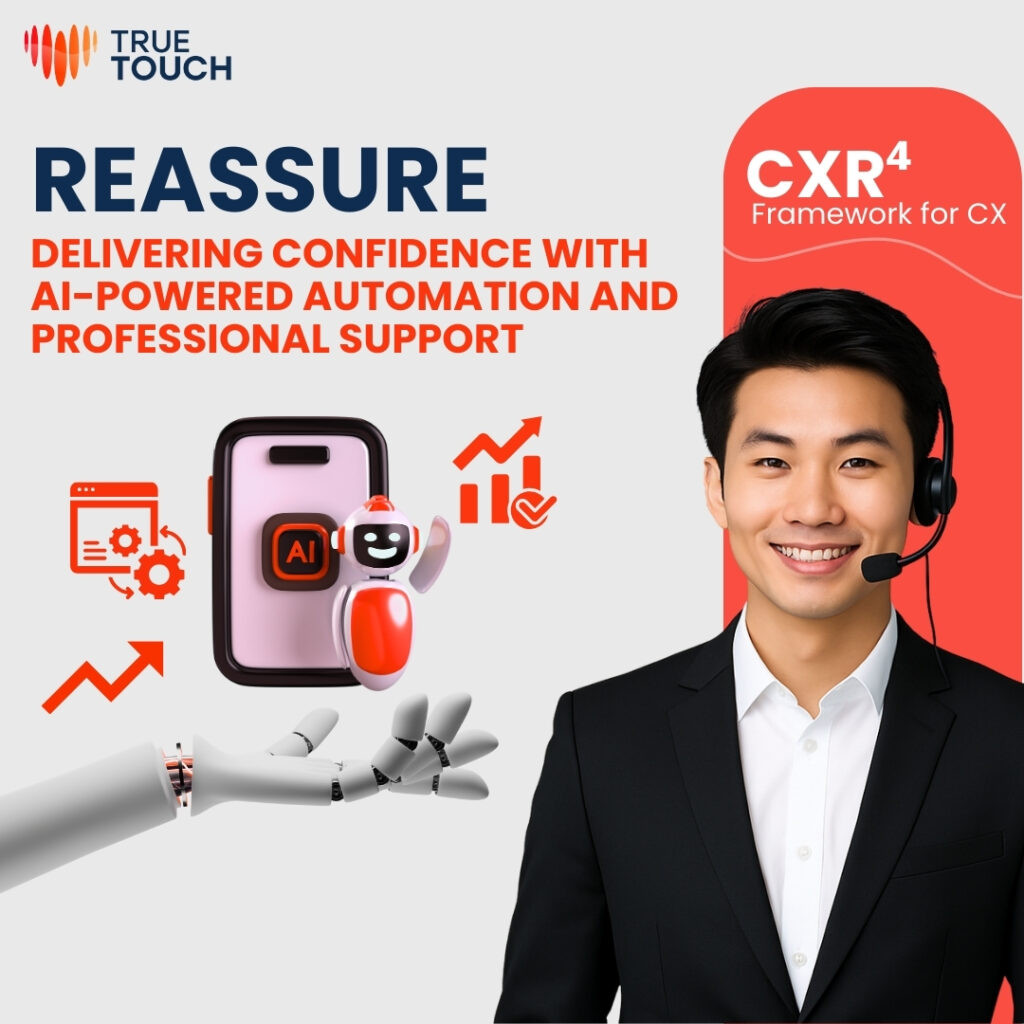
CXR⁴ framework for CX by True Touch CXR⁴ framework for CX by True Touch CXR⁴ framework for CX by True Touch CXR⁴ framework for CX by True Touch

True Touch and raising service excellence

True Touch has more than 20 years of experience providing Contact Center and customer experience solutions for organizations in both the public and private sectors in Thailand

Through the True Touch Total CX Solutions approach, True Touch helps organizations connect people, process, technology and data to raise the Contact Center into something more than a customer service centre

covering

  • Omnichannel Contact Center
  • AI Customer Experience
  • Voice of Customer Analytics
  • Workforce Optimization
  • Quality Assurance
  • Operational Dashboard
  • Customer Journey Improvement

For organizations that want to scale the business, the Service Excellence Framework is the foundation that lets growth come with quality, trustworthiness and a sustainable customer experience

Related references

The ideas in this article line up with international standards and guidance on Contact Center, customer experience and quality management, such as

  • ISO 18295-1: Customer Contact Centres Standard
  • ISO 9001: Quality Management System
  • ISO 27001: Information Security Management System
  • Gartner Customer Service Experience & Benchmarking Guidance
  • Approaches to measuring customer experience such as CSAT, NPS, CES and FCR

These sources reflect that an effective Contact Center has to attend to quality, efficiency, data security and the continuous development of the customer experience alike

In summary: service excellence is the framework for growth

In 2026 the organizations that win are not merely the ones that answer the phone fastest, but the ones that create the best customer experience and genuinely turn service work into business value

The Service Excellence Framework is therefore an important tool for raising the Contact Center from meeting an SLA to producing measurable results for customers, operations and the business alike

Once an organization connects people, process, technology and data, the Contact Center is no longer merely a service function but becomes a strategic asset driving the organization's growth over the long term

🚀 Raise your Contact Center with the Service Excellence Framework

Click here to contact us for a free plan

If your organization is looking for a way to

  • Raise the Contact Center from SLA to business value
  • Make the customer experience genuinely measurable
  • Use AI and data to increase service efficiency
  • Develop an omnichannel Contact Center
  • Analyse the Voice of Customer systematically
  • Turn the Contact Center into a business insight hub

True Touch is ready to support your organization with more than 20 years of experience in Contact Center and customer experience solutions

to help your organization

“Transform Service Into Measurable Business Value”

📩 Contact us for a consultation or a demo at

📞 Tel: +66(0)2088-8999✉️ Email: [email protected]🌐 Website: www.truetouch.co.th

📩 Contact us today to turn every customer voice into sustainable growth.

❓FAQ

Q1: What is the Service Excellence Framework?

A1: The Service Excellence Framework is a way of thinking about developing service quality systematically, connecting people, process, technology, data and customer experience in order to raise both service quality and business value

Q2: How does the Service Excellence Framework differ from an SLA?

A2: An SLA focuses on measuring the level of service, such as speed and response time, whereas the Service Excellence Framework takes a broader view covering customer experience, quality, efficiency and business impact

Q3: Why does a Contact Center have to move from SLA to business value?

A3: Because customers do not want merely a fast response; they want the problem resolved correctly and consistently in a way that builds confidence, which directly affects retention, loyalty and brand trust

Q4: How does AI help service excellence?

A4: AI increases service efficiency through chatbots, AI Agent Assist, voice analytics, sentiment analysis and smart routing, but it still has to work alongside human agents to preserve empathy and service quality

Q5: How should an organization start with the Service Excellence Framework?

A5: Start by analysing the customer journey, reviewing the current KPIs, finding the pain points and root causes, adjusting the process, using data to measure, and building a cycle of continuous improvement


True Touch True Touch Call Center