
Why are the traditional Contact Center KPIs “no longer enough”?
In the past, measuring a Contact Center tended to focus on basic KPIs such as
- AHT (Average Handling Time)
- CSAT (Customer Satisfaction Score)
- Service Level
But in an era where the Customer Experience (CX) has become a business driver
the questions executives are starting to ask are:👉 “Why is CSAT good but customers still do not buy again?”👉 “We reduced AHT, so why is total cost still high?”
This is the point at which an organization has to shift fromoperational KPIs → business KPIs
and start paying attention to Contact Center KPIs that can genuinely measure “business results”
What are Contact Center KPIs?
Contact Center KPIs (Key Performance Indicators) are the measures used to assess the performance of a Contact Center
But in the modern view, KPIs do not measure only “working well”👉 they have to reflect “what effect this has on the business”
Experience Insight: what we actually see inside organizations
From True Touch Company Limited's experience running and developing contact centres
we see a clear pattern:
❌ Traditional KPIs
- Low AHT = good
- High call count = high productivity
- High CSAT = satisfied customers
👉 But they still cannot answer “is the business growing?”
The new kind of KPI (business-driven KPI)
- Has cost per contact come down?
- Are customers coming back to use the service again?
- Has First Contact Resolution (FCR) improved?
- Is the Contact Center helping increase revenue?
👉 KPIs have to connect to “profit & growth”
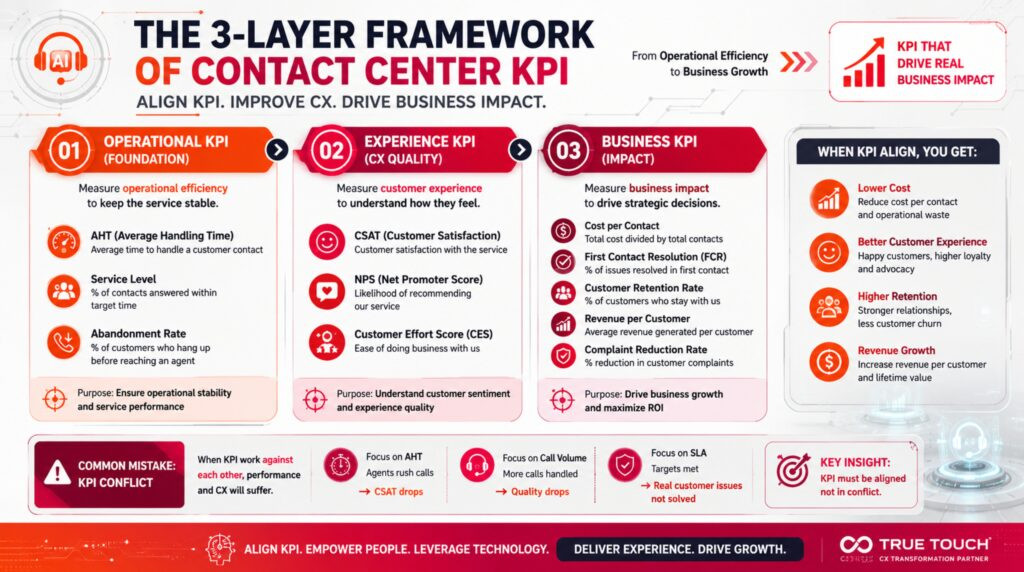
Framework: the 3 layers of Contact Center KPIs an organization needs
For Contact Center KPIs to create genuine business impact, we suggest dividing them into 3 layers:
1. Operational KPI (the basics you must have)
Measuring “efficiency of work”
For example:
- AHT (Average Handling Time)
- Service Level
- Abandonment Rate
👉 Used to keep the operation stable
2. Experience KPI (measuring CX quality)
Measuring “the customer experience”
For example:
- CSAT (Customer Satisfaction)
- NPS (Net Promoter Score)
- Customer Effort Score (CES)
👉 Used to assess “how the customer feels”
3. Business KPI (the measures to focus on) 🔥
Measuring “the effect on the business” for real
For example:
- Cost per Contact
- First Contact Resolution (FCR)
- Customer Retention Rate
- Revenue per Customer
- Complaint Reduction Rate
👉 These are the KPIs executives “use to make business decisions”
Common Mistake: KPIs that work against each other
Many organizations hit conflicting KPIs, for example:
- Reduce AHT → agents rush to end the call → CSAT falls
- Focus on call volume → quality falls
- Focus on SLA → the customer's problem is not really solved
👉 The key insight is that KPIs have to align, not compete with one another
How to Shift: from the old KPIs → to KPIs that create business impact
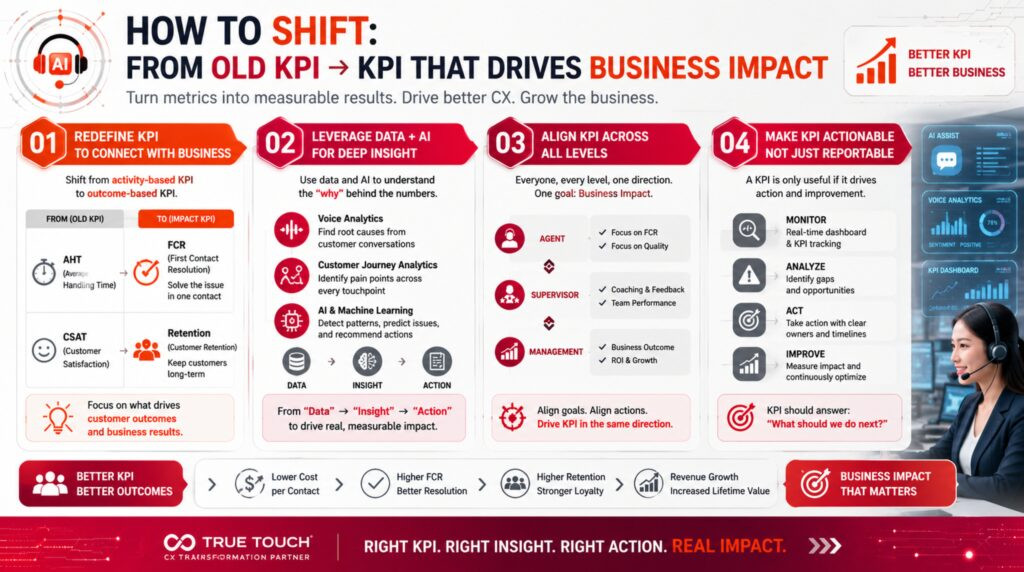
1. Redefine the KPIs so they connect to the business
For example:
- From AHT → raise FCR so the problem is finished in one go
- From CSAT → raise retention to keep customers over the long term
2. Use data + AI to analyse in depth
For example:
- Voice analytics to find the root cause
- Customer journey analysis of pain points
👉 From “data” → “insight” → “action”, so the result can genuinely be used
3. Align the KPIs at every level of the organization
- Agent → focus on FCR + quality
- Supervisor → coaching + performance
- Management → business outcome
👉 Every level has to “drive the KPIs in the same direction”
4. Make the KPIs actionable
Not merely “looking at the number” but knowing “what has to change”
Case Insight: change the KPI → change the result
Organizations that successfully adjust their Contact Center KPIs tend to see impacts such as:
- Cost per contact down 15–25%
- Higher FCR, so repeat calls fall
- Higher customer retention
- Fewer complaints and escalations
👉 Good KPIs = both “happy customers + a growing business”
Why True Touch: KPIs that are more than reporting
As a CX transformation partner, True Touch Company Limited
does not see KPIs as merely a dashboard but as “a tool for driving the business”
Our approach:
- Design KPIs that connect operations → business
- Use AI & analytics to find insight in depth
- Turn KPIs into an action plan that genuinely works
👉 The goal is to make the Contact Center a profit centre, not a cost centre
In summary: Contact Center KPIs have to measure “results”, not merely “efficiency”
In a CX-driven business
the organizations that win are not the ones with “the most KPIs” but the ones with “the right KPIs”
👉 From AHT → to FCR👉 From CSAT → to retention👉 From operations → to business impact
🚀 Upgrade your Contact Center KPIs today
Click here to contact us for a free plan If your organization is:
- Measuring KPIs but seeing no clear business result
- Wanting to cut cost while keeping CX quality
- Wanting data to produce real impact
👉 Let us help you “redesign your KPIs towards business impact”
✔ Request KPI Assessment✔ Consult with CX Expert✔ Explore AI-Driven Contact Center Solutions
📩 Contact us for a consultation or a demo at
📩 Contact us today to turn every customer voice into sustainable growth.
True Touch – Serve your customers as if our own
❓FAQ
Q1: What is the most important Contact Center KPI?
A1: There is no single most important KPI, but FCR, cost per contact and customer retention are the measures that connect most clearly to business impact
Q2: Does AHT still matter?
A2: It still matters operationally, but it should not be used as the single main KPI. It should be balanced against service quality and business results
Q3: Which KPIs genuinely reduce cost?
A3: Cost per contact, FCR and automation rate are the KPIs that reduce cost directly, through efficiency and cutting repetitive work
Q4: How do you know whether the KPIs you use are “right”?
A4: Consider whether the KPI connects to a business outcome such as revenue, retention or cost
Q5: How should you start adjusting the KPIs in your organization?
A5: Start by assessing the current KPIs → find the gap → redesign the KPIs so they connect to CX and business impact