

: Where Should Customer Operations Start for Faster and More Cost-Effective Results?

Many organizations are beginning to recognize the potential of AI in customer service, whether through Chatbots, Voicebots, Agent Assist, AI Quality Assurance, Automation, or Agentic AI that can support multi-step operations.
“What can AI do?”
“Where should an organization start using AI to create real value while keeping risks under control?”
This is where AI Use Case Prioritization becomes important. It helps organizations evaluate and prioritize AI initiatives based on business value, operational readiness, technical feasibility, and risk, rather than adopting technology simply because it is trending.
Microsoft recommends evaluating AI use cases across multiple dimensions, such as Business Impact, Technical Feasibility, and User Desirability. Google Cloud similarly suggests considering expected value alongside feasibility to identify initiatives that are most likely to deliver measurable results before expanding investment.
AI Use Case Prioritization is the process of identifying, evaluating, and ranking potential AI use cases so that organizations can determine which initiatives should begin first, which should move into a Pilot, which require greater data or system readiness, and which may not yet justify investment.
Prioritization is therefore not about choosing the most advanced or fashionable technology. It is about selecting initiatives that address real business needs, are sufficiently ready, and can produce measurable outcomes.
Microsoft notes that systematic AI use case prioritization can reduce implementation risk and accelerate value creation. Organizations should consider AI readiness, data availability, infrastructure, and workforce capabilities for each use case.
However, these use cases vary significantly in complexity and risk.
For example, using AI to summarize conversations and reduce documentation time is less complex and lower risk than allowing AI to approve refunds or modify important customer information.
Launching multiple initiatives at the same time without clear prioritization can spread budgets, data, people, and Integration capabilities too thinly, while making it difficult for any single initiative to demonstrate meaningful results.
A more practical approach is to select a limited number of use cases, run Pilots, measure the outcomes, and use the lessons learned to establish standards for future initiatives.
A Proof of Concept can also help validate both technical feasibility and business value before full-scale development.
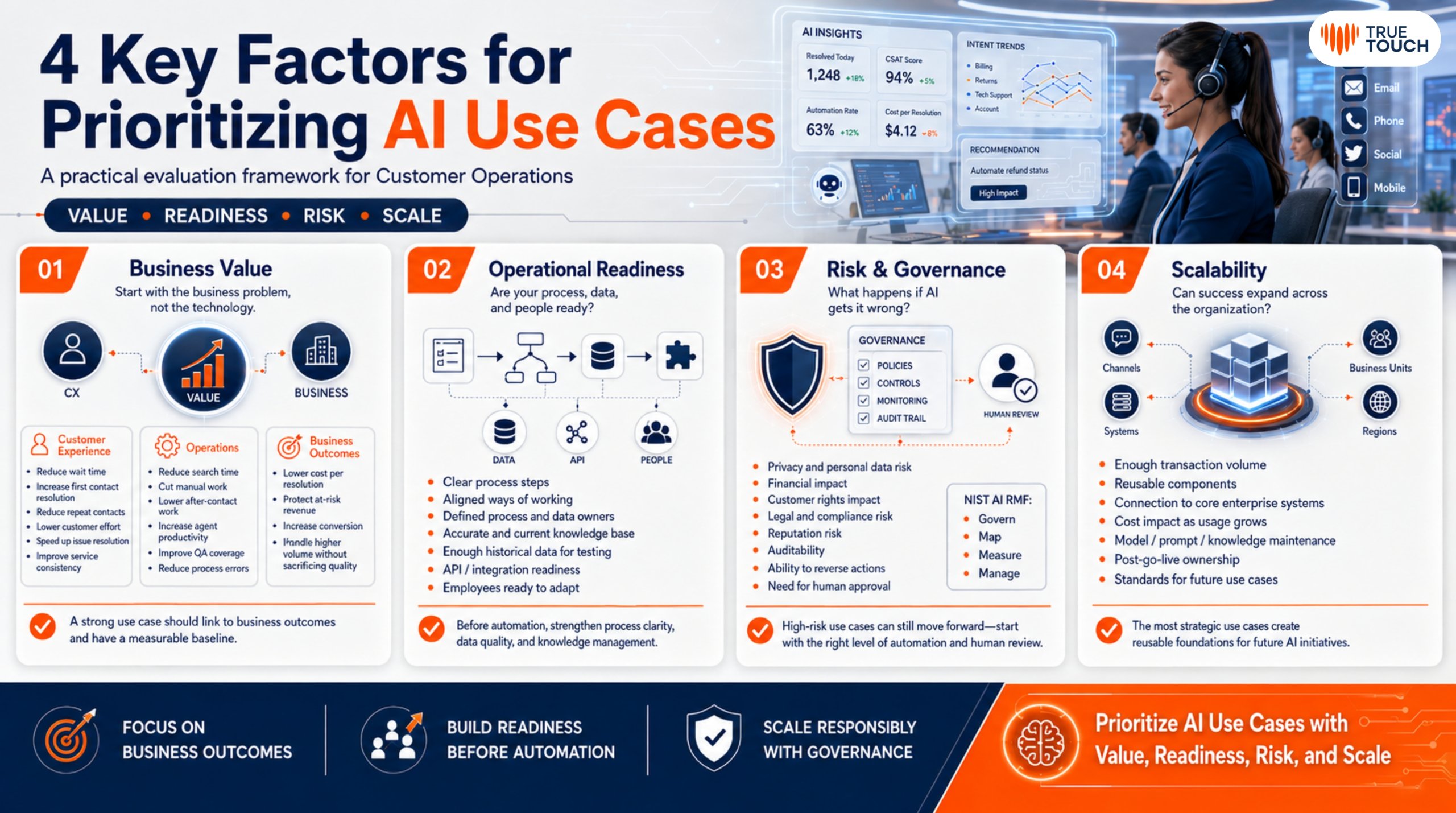
Value – Readiness – Risk – Scale
Start by identifying the problem to be solved, not by selecting a technology.
Organizations should ask what outcomes the use case will create.
A strong use case should be linked to a clear Business Outcome and have a Baseline that allows results to be compared before and after implementation.
Google Cloud recommends beginning AI initiatives with a clearly defined business problem and ensuring that there is an accountable business sponsor who can drive adoption and results, rather than experimenting with technology without clear ownership.
Even when a use case has high Business Impact, implementation may take longer than expected if the Process and Data are not ready.
If a process contains many exceptions, lacks clear Business Rules, or relies on fragmented data across multiple systems, introducing AI may not reduce complexity. Instead, it may transfer existing ambiguity into the new system.
Before automating, organizations may therefore need to strengthen Process Design, Data Quality, and Knowledge Management first.
Using AI to recommend Knowledge Base content to an Agent is very different from allowing AI to change a customer’s package, cancel a service, process a refund, or modify personal information.
The NIST AI Risk Management Framework organizes AI risk management into four core Functions:
Govern – Map – Measure – Manage
The framework emphasizes continuous risk assessment and management throughout the AI lifecycle.
High-risk use cases do not necessarily need to be rejected. Instead, organizations can begin with an appropriate level of Automation, such as allowing AI to recommend or prepare information while requiring employees to review or approve the final action.
Some AI use cases may work well within a small team but become difficult to scale across multiple channels, products, or Business Units.
Use cases that allow organizations to reuse Data Pipelines, Integrations, Security Controls, or Governance Frameworks often create greater Strategic Value than solutions built for a single isolated task
Organizations can map AI use cases by comparing Business Value with Implementation Readiness.
| Category | Characteristics | Recommended Approach |
|---|---|---|
| Quick Win | High Business Value and high readiness | Start with a Pilot |
| Strategic Initiative | High Business Value but low readiness | Build a Roadmap and prepare data and systems |
| Efficiency Support | Moderate Business Value but relatively easy to implement | Use for short-term learning and efficiency gains |
| Low Priority | Low value, low readiness, or high risk | Delay or reconsider the need |
Google Cloud proposes a similar approach by considering Expected Value together with Feasibility and Actionability, helping executives understand trade-offs and align on investment priorities.
| AI Use Case | Business Value | Readiness | Risk | Recommendation |
| Automated conversation summarization | High | High | Low | Start Pilot |
| Agent response recommendations | High | Medium–High | Low–Medium | Pilot with Human Review |
| Complaint classification | Medium–High | High | Medium | Pilot and validate Accuracy |
| Quality monitoring for every interaction | High | Medium | Medium | Start with clearly defined criteria |
| Customer sentiment analysis | Medium | Medium | Medium | Use as a supporting Signal, not the sole conclusion |
| Automated customer data changes | High | Medium | High | Require Authentication and Approval |
| Automated refunds | High | Low–Medium | Very High | Start with Recommendation |
| Agentic AI for End-to-End resolution | Very High | Depends on systems | High | Develop in phases with Guardrails |
This table is intended as a general guideline. Actual scoring should be based on each organization’s Process, Data, Technology, and business requirements.
Based on more than 20 years of True Touch experience in Contact Center management and Customer Experience Solutions, successful AI use cases often do not begin with the most complex technology.
Before selecting an AI use case, organizations should ask:
Applying AI on top of an existing Process without first analyzing the Root Cause may make the current process faster, but it does not necessarily mean that the customer’s problem will be solved more effectively.
A more effective approach is to connect People, Process, Technology, and Data, while measuring the impact across Efficiency, Customer Experience, and Business Outcomes.
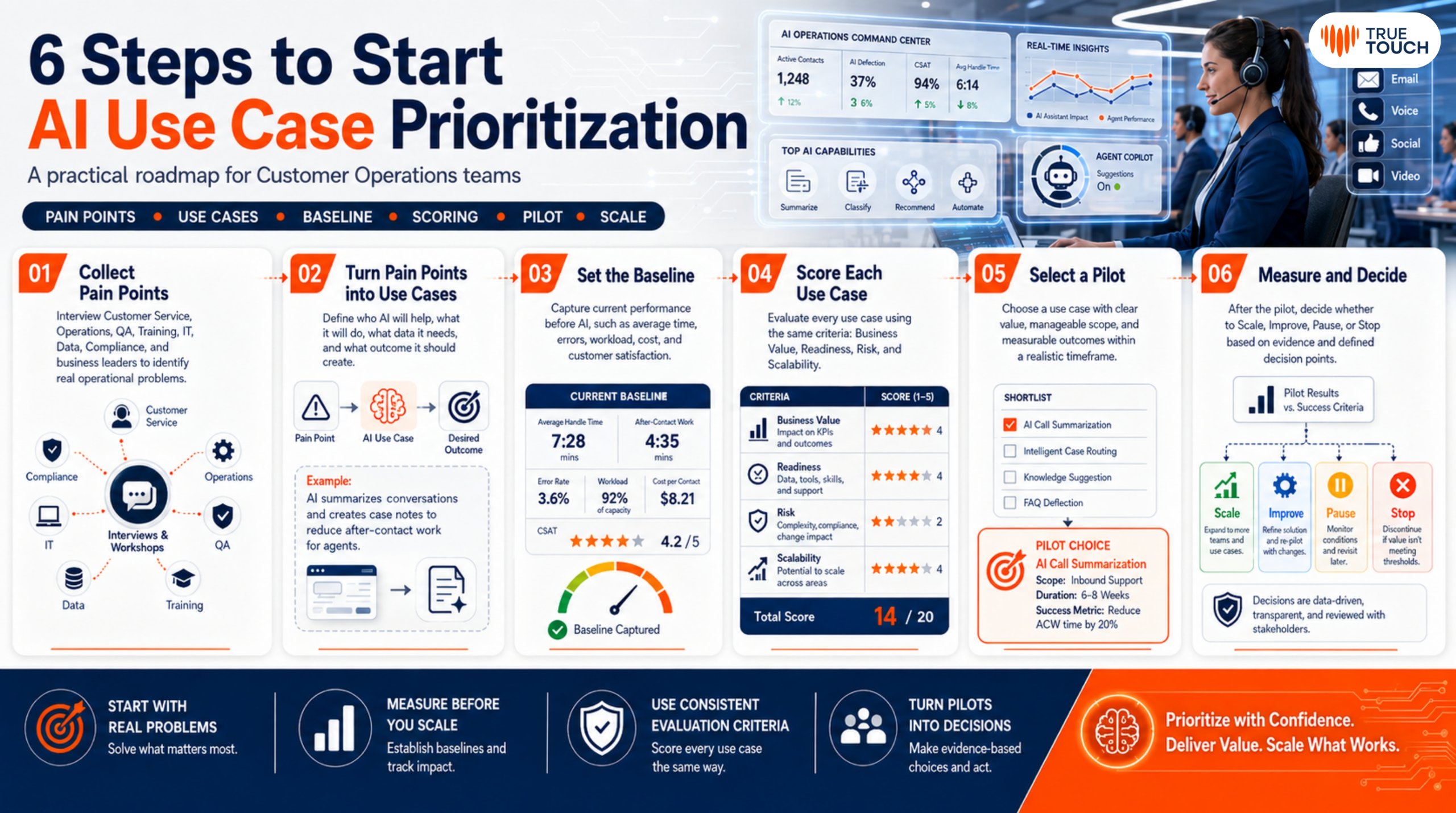
Interview stakeholders across Customer Service, Operations, QA, Training, IT, Data, Compliance, and management to identify real operational problems
Clearly define:
For example:
Use AI to summarize conversations and generate Case Notes to reduce Agent After Contact Work.
Capture current performance before implementing AI, including metrics such as:
These Baselines will allow the organization to compare results after implementation.
Evaluate each use case using the same criteria:
Using consistent criteria makes comparison across initiatives more objective.
Choose a use case that offers clear value, has a manageable scope, and can produce measurable results within a realistic timeframe.
After the Pilot, organizations should make a clear decision:
Pilot projects should not continue indefinitely without defined decision criteria or clear decision points.
AI Use Case Prioritization helps organizations move away from fragmented AI experimentation toward a more structured investment approach that is clearly connected to business outcomes.
The use case that should start first does not need to be the most sophisticated.
Instead, it should have:
The key principle is:
Start with the problem, not the technology.
Choose measurable use cases, test them within a controlled scope, and scale only after value has been proven.
With a clear prioritization framework, AI can move beyond being an experimental project and become an Operational Capability that continuously improves Customer Experience and creates sustainable Business Impact.
Consult with True Touch Experts
True Touch is ready to help organizations analyze Customer Journeys, identify Pain Points, assess readiness, and prioritize AI use cases that align with business objectives.
With more than 20 years of experience in Contact Center and Customer Experience Solutions, we help connect People, Process, Technology, and Data so that AI initiatives can create measurable results while maintaining appropriate quality and risk controls.
A1: ควรประเมินอย่างน้อย 4 ด้าน ได้แก่ Business Value, Operational Readiness, Risk and Governance และ Scalability เพื่อให้เห็นทั้งคุณค่า ความพร้อม ความเสี่ยง และโอกาสในการขยายผลของแต่ละ Use Case
A2: A suitable Pilot should involve sufficient transaction volume, repeatable work, clearly defined processes and data, manageable risk, and measurable KPIs. Examples include conversation summarization, Agent recommendations, or Case classification.
A3: Both should be included in the Roadmap. Organizations can begin with Quick Wins to generate short-term results and learning, while simultaneously preparing Data, Integration, and Governance for Strategic Use Cases that can create greater Business Impact over the longer term.