
Customer Win-Back, a strategy designed to encourage former customers to return and use a company's products or services again, has become an increasingly important priority for many organizations.
Existing customers are already familiar with the brand, and their previous purchase or service histories provide valuable information that can help businesses understand their needs more deeply than those of new customers.
However, winning back customers involves more than simply offering promotional discounts. Organizations must first understand why customers stopped engaging with the brand and then redesign the Customer Experience (CX) to address their actual needs.
In this article, True Touch explores Customer Win-Back strategies, from identifying early warning signs and applying effective customer re-engagement techniques to systematically measuring campaign performance.

Customer Win-Back is a strategy aimed at re-engaging customers who previously purchased products or used services but have since become inactive or stopped using them, commonly referred to as Lapsed or Churned Customers.
This strategy involves analyzing the reasons customers left, communicating targeted offers based on the needs of specific customer segments, and addressing unresolved issues that previously caused dissatisfaction.
The ultimate objective is not simply to encourage customers to make another purchase but to rebuild stronger and more sustainable customer relationships.
To better understand this approach, the following table compares Customer Win-Back with Customer Retention, which many organizations already practice.
| Comparison Criteria | Customer Retention | Customer Win-Back |
| Target Customers | Customers who are still actively using products or services. | Customers who have stopped using services or become inactive. |
| Timing | Continuous throughout the customer relationship. | After customers are identified as inactive based on predefined criteria. |
| Primary Objective | Prevent existing customers from leaving. | Re-engage former customers and address the reasons they left. |
| Example Strategies | Loyalty programs and after-sales support. | Personalized offers, proactive outreach, and resolution of previous complaints. |
The importance of Customer Win-Back strategies can be summarized through the following key benefits:

Some customers may display warning signs before they stop using a product or service.
When organizations recognize these signals early, they have an opportunity to intervene before customer relationships deteriorate completely.
The five key warning signs include:
The challenge is that these warning signs help organizations identify customers at risk of leaving, allowing them to implement appropriate preventive Customer Retention measures.
Once customers have stopped using a service or canceled their subscriptions, organizations can use relevant historical usage data and identified reasons for leaving to develop a Customer Win-Back Strategy that encourages them to return.

Once an organization identifies which customers have become inactive and understands why they left, the next step is to select appropriate strategies for each customer segment.
The focus should be on Proactive Customer Service, where the organization takes the initiative to reconnect with customers rather than waiting for them to return independently.
Offering the same incentive to every customer often produces limited results because customers leave for different reasons.
Organizations should therefore apply Customer Segmentation before developing personalized Win-Back offers.
Examples include:
Personalized offers must be developed using customer data for which appropriate consent has been obtained.
Both the use of purchase histories and customer outreach should align with the purposes communicated to customers under PDPA requirements, ensuring that Win-Back initiatives do not undermine customer trust.
Timing can influence customer decisions just as significantly as the offers themselves.
Setting automated communication triggers based on periods of customer inactivity helps organizations reconnect with customers at appropriate times.
The ideal timing depends on the purchasing or service usage cycle of each product or service.
Generally, a Win-Back communication sequence can be divided into three stages:
Automation helps ensure timely and consistent communication across larger customer groups.
However, high-value or strategically important customers may still require direct human interaction.
Outbound Contact Center teams therefore play an important role in following up with customers, listening to their concerns, and offering more flexible solutions than standardized automated messages.
Importantly, organizations must establish appropriate contact frequencies to avoid making customers feel overwhelmed or disturbed.
Customers who leave because of negative experiences are often unlikely to return simply because they receive a discount.
They are more likely to reconsider the brand when they see that their previous problems have genuinely been resolved.
This approach focuses on closing the loop on customer issues through the following actions:
Unexpected rewards or special benefits can make customers feel valued and demonstrate that the brand genuinely cares about their relationship.
However, organizations should avoid creating the expectation that customers will automatically receive discounts whenever they stop using a service.
Effective incentives do not always need to involve price reductions.
Examples include:
A Customer Win-Back campaign can only be continuously improved when organizations systematically measure its performance.
This requires evaluating both the number of customers who return and the quality of their relationships with the brand after re-engagement.
The following Key Performance Indicators (KPIs) should be monitored:
| KPI | What It Measures | How It Supports Decision-Making |
| Win-Back Rate | Number of customers who return ÷ Total target customers in the campaign × 100. | Evaluates overall campaign effectiveness. |
| Response Rate | Percentage of customers who respond to outreach through each communication channel. | Helps select effective communication channels and message formats. |
| Repeat Purchase Rate | Percentage of returning customers who make additional purchases or continue using services. | Determines whether customers genuinely return or only take advantage of a one-time offer. |
| Re-Churn Rate | Percentage of returning customers who leave again. | Helps assess whether the original reasons for leaving have been adequately addressed. |
| CLV of Returning Customers | Value generated by customers after re-engagement. | Evaluates campaign value relative to its costs. |
| Post-Contact CSAT / NPS | Customer satisfaction following Win-Back communications. | Supports improvements in customer conversations and service quality. |
In addition to tracking performance indicators, organizations should implement appropriate tools to make the information actionable.
The results of each campaign depend on the business model, reasons customers left, and the quality of available customer data.
Continuous testing and improvement are therefore more important than focusing on a single performance target.
Successful Customer Win-Back strategies require accurate customer information, clearly defined processes, and professional teams capable of communicating with empathy and understanding.
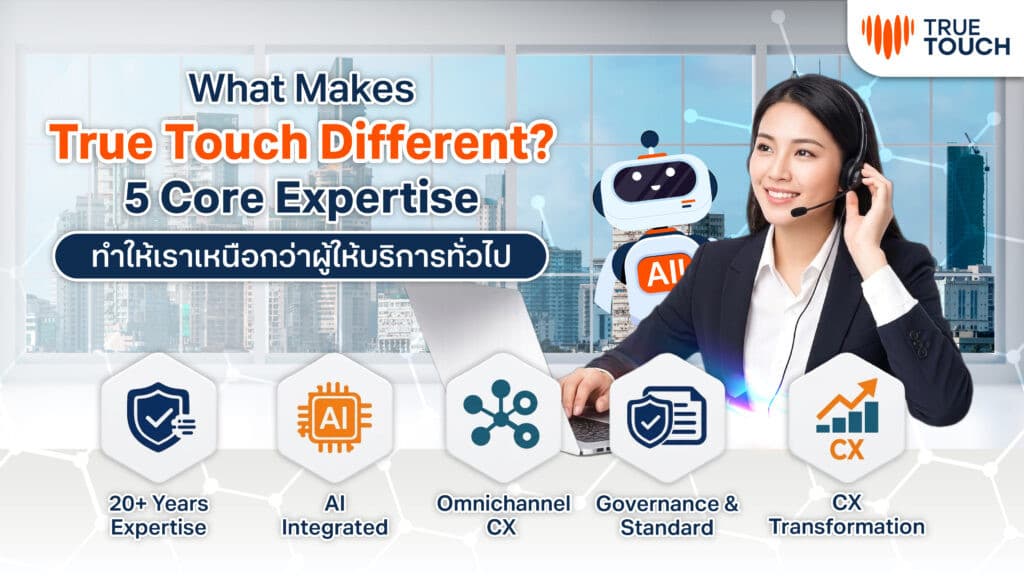
With more than 20 years of Contact Center experience, True Touch provides comprehensive Omnichannel Customer Service, covering Inbound, Outbound, and Non-Voice services, including Chat, Email, and Social Media.
Our service approach is guided by the CXR⁴ Framework, which integrates human expertise with technology across four key dimensions:
At True Touch, we believe in "Caring for Your Customers as If They Were Our Own."
For more information, please contact:
Tel: +66 (0)2 088 8999
Email: [email protected]
Website: https://www.truetouch.co.th/en
Customer Retention focuses on maintaining relationships with existing customers and preventing them from leaving.
Customer Win-Back, on the other hand, focuses on reaching out to customers who have already stopped using a product or service to understand why they left, address previous issues, and rebuild relationships that encourage them to return.
Organizations should begin by monitoring declining purchase frequency and service usage, reduced engagement through email or chat, and outstanding customer complaints.
Identifying these warning signs early enables businesses to take proactive retention measures before customers decide to permanently discontinue their services.
Discounts may appeal to customers who left primarily because of pricing concerns.
However, for customers who stopped using a service due to negative experiences, the most important factors are demonstrating sincerity, acknowledging previous issues, and proving that the original problems have been resolved.
Organizations should segment customers based on their previous behavior, communicate through preferred channels, establish appropriate contact frequencies, and deliver relevant messages at the right time.
All communication activities should comply with applicable customer consent and personal data protection requirements under the PDPA.
Outsourced Contact Center providers offer experienced Outbound teams skilled in customer communication and negotiation, Omnichannel technologies that connect customer information, and structured performance monitoring systems.
These capabilities help organizations proactively reconnect with former customers, understand their concerns, and deliver professional customer engagement experiences.