A key strategy for CX transformation & operational excellence

In an era where the customer experience has become central to business competition, many organizations no longer want merely “a good service”; they want a service that can be measured, improved and turned into genuine business impact
The important question for the modern organization is therefore no longer only
“are customers satisfied?” but
“how do we know the customer's experience has genuinely improved, and what effect does that have on the business?”
This is the starting point of Data-Driven Customer Operations — running customer service on data, to turn the customer experience from something hard to measure into a system that can be seen, analysed and improved continuously
For organizations undertaking CX transformation and operational excellence, data is not merely a measurement tool but the “navigation system” that makes every decision about customers more accurate, faster and more productive for the business
What is Data-Driven Customer Operations?
Data-Driven Customer Operations means taking data from every customer touchpoint — Contact Center, chat, email, social media, CRM, surveys, Voice of Customer and back-office systems — and analysing it in order to run customer operations systematically
The goal is to let the organization answer important questions such as
- What do customers get in touch about most?
- Which problem causes repeated complaints?
- Which channel is most effective?
- Which point in the journey wastes the customer's time?
- What support or training do agents need?
- Which process should automation start with?
- Has CX genuinely improved compared with business KPIs?
Put simply, Data-Driven Customer Operations makes the customer experience not merely “a feeling” but something that can genuinely be measured, managed and improved
Why does an organization need data to raise the customer experience?
Many organizations have a great deal of customer data but still cannot turn it into insight
The data may be scattered across several systems, such as
- Contact centre system
- CRM
- Chat platform
- Email ticketing
- Social media
- Survey platform
- Sales system
- Complaint management
- Quality monitoring
If this data is not connected, the organization sees only “part of the picture” of the customer, not the complete customer journey
From experience working in Contact Center and customer experience, the main problem for many organizations is not the absence of data but that
“there is plenty of data, but it is not used systematically”
The consequences are
- Fixing the symptom rather than the root cause
- Measuring CX without connecting it to business impact
- Customers having to get in touch about the same thing again
- The operations team working reactively rather than proactively
- Executives without a dashboard that reflects the real situation
Data-Driven Customer Operations is therefore an important step in turning CX from day-to-day service work into a strategy for the growth of the business
How does data change the customer experience?
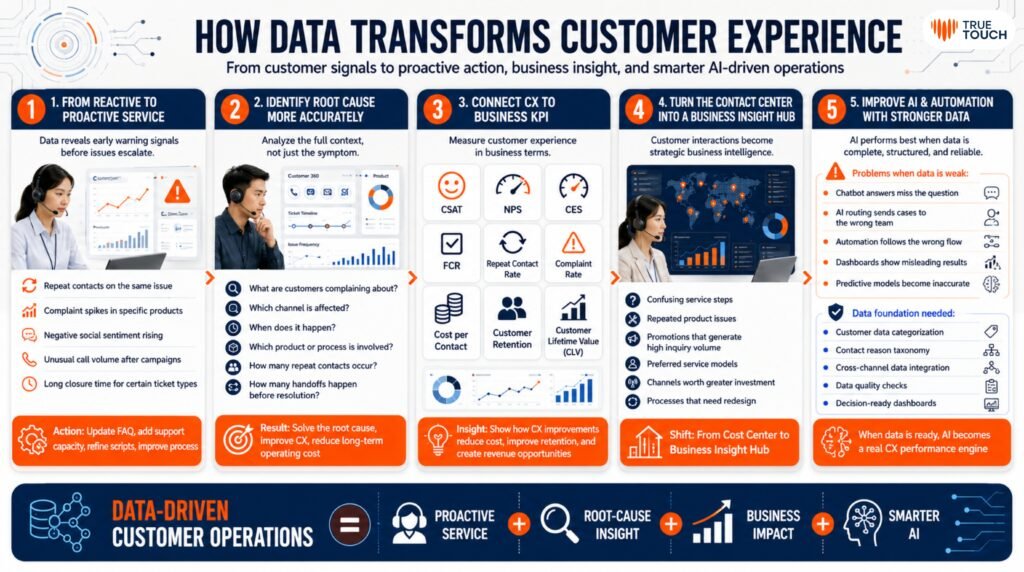
1. From reactive service to proactive service
In the past, customer operations tended to work reactively — waiting for the customer to get in touch and then solving the problem
With data, an organization can see the patterns and the warning signs in advance, such as
- Customers getting in touch about the same thing several times
- Complaints starting to rise on a particular product
- Negative sentiment rising on social media
- Call volume rising abnormally after a campaign
- Certain kinds of ticket taking longer than usual to close
Seeing these signals, an organization can design an action plan in advance — adjusting the FAQ, adding a dedicated team, adjusting the script, or fixing the process before the problem grows
This is the shift from “waiting for problems” to “managing the customer experience proactively”
2. Find the root cause of a problem more accurately
One of the most important values of Data-Driven Customer Operations is helping an organization see the root cause
For example, if complaints rise, the organization should not look only at “the agent answered badly” but analyse further:
- What are customers complaining about?
- On which channel?
- At which time?
- Related to which product or process?
- How many times does the customer have to get in touch?
- How many departments does the case pass through before it is resolved?
With the data analysed in full, an organization can fix the problem at its source rather than only at the end of the line
The result is a genuinely better customer experience and lower operating cost over the long term
3. Measure CX so it connects to business KPIs
A good customer experience should not stop at a satisfaction score
An organization should measure CX in a way that connects to business KPIs, such as
- Customer Satisfaction (CSAT)
- Net Promoter Score (NPS)
- Customer Effort Score (CES)
- First Contact Resolution (FCR)
- Repeat Contact Rate
- Complaint Rate
- Cost per Contact
- Customer Retention
- Customer Lifetime Value (CLV)
Once CX KPIs connect to business KPIs, the organization can answer its executives clearly:
“what effect does improving the customer experience have on the business?”
For example, fewer repeat contacts, lower cost per case, higher customer retention, or more opportunity to cross-sell and upsell
4. Raise the Contact Center into a business insight hub
The Contact Center is one of the most valuable sources of customer data an organization has, because every day the customer's voice flows in through several channels
Analysed systematically, this data lets the Contact Center reflect important insight back to the business, such as
- Which step confuses customers
- Which product has recurring problems
- Which promotion generates a lot of questions
- What kind of service customers want
- Which channel deserves more investment
- Which process should be improved
This is the shift of the Contact Center from a “cost centre” to a “business intelligence hub”
Not merely taking customer enquiries, but helping the organization decide better on real data
5. Make AI and automation more accurate
How well AI and automation work depends on the quality of the data
If the data is incomplete, unclean or unstructured, an organization may hit problems such as
- The chatbot answering the wrong question
- AI routing sending the case to the wrong team
- Automation running the wrong flow
- Dashboards reflecting data that is not true
- Predictive models analysing inaccurately
Before bringing AI into customer operations, an organization therefore has to get the data foundation ready, for example
- Categorising customer data
- Defining a taxonomy of contact reasons
- Connecting data from several channels
- Checking data quality
- Building a dashboard that can genuinely be used to decide
With the data ready, AI is not merely “new technology” but a tool that genuinely increases the efficiency of the customer experience
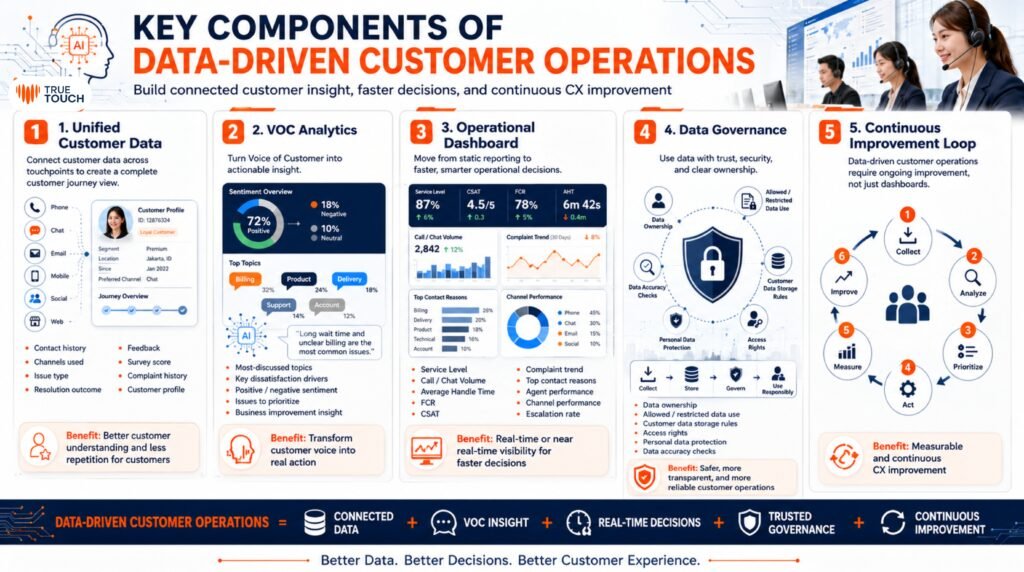
The key components of Data-Driven Customer Operations
1. Unified Customer Data
An organization has to bring customer data together from several touchpoints to create an overall picture of the customer journey
The data that should be connected includes
- Contact history
- The channels the customer uses
- The type of problem
- The outcome of the resolution
- Feedback
- Survey scores
- Complaint history
- Customer profile
Once the data is connected, the team understands the customer better and the customer does not have to explain again
2. VOC Analytics
Voice of Customer, or VOC, is the data that reflects customers' needs, dissatisfaction and pain points directly
VOC analytics helps an organization understand
- What customers talk about most
- Which issues create dissatisfaction
- Whether sentiment is positive or negative
- Which problem should be fixed first
- Which insight can be used to develop the business
Used systematically, VOC lets an organization genuinely turn the customer's voice into action
3. Operational Dashboard
A good dashboard is not merely a report of past numbers; it has to help executives and the operations team decide faster
The dashboard should show data such as
- Service level
- Call / chat volume
- Average handle time
- FCR
- CSAT
- Complaint trend
- Top contact reasons
- Agent performance
- Channel performance
- Escalation rate
Seeing the data in real time or near real time, the team can adjust its plan faster than before
4. Data Governance
Using data to raise CX has to come with trustworthiness and security
An organization should set out an approach covering
- Who owns the data
- What data may and may not be used
- How customer data is stored
- Rights of access to the data
- Protection of personal data
- How the accuracy of the data is checked
Data governance makes the use of data in customer operations secure, transparent and trustworthy
5. Continuous Improvement Loop
Data-Driven Customer Operations does not end with building a dashboard
It needs a continuous improvement cycle, such as
- Collect: gather data from every touchpoint
- Analyze: analyse the insight and the root cause
- Prioritize: choose the problems that affect CX and the business most
- Act: design an action plan
- Measure: measure the result after the change
- Improve: keep developing
This cycle lets an organization create a better customer experience in a way that can genuinely be measured
Data-Driven Customer Operations and True Touch's CXR4 Framework
True Touch uses the CXR4 Framework to help organizations raise the customer experience systematically, and Data-Driven Customer Operations plays an important part in every dimension of it
Reach :
Using data to understand which channel customers are on, what they get in touch about and what kind of experience they want, in order to design an omnichannel Contact Center that answers those needs
Reassure :
Using AI, automation and human expertise together with customer data to create a service that is fast, accurate and reassuring
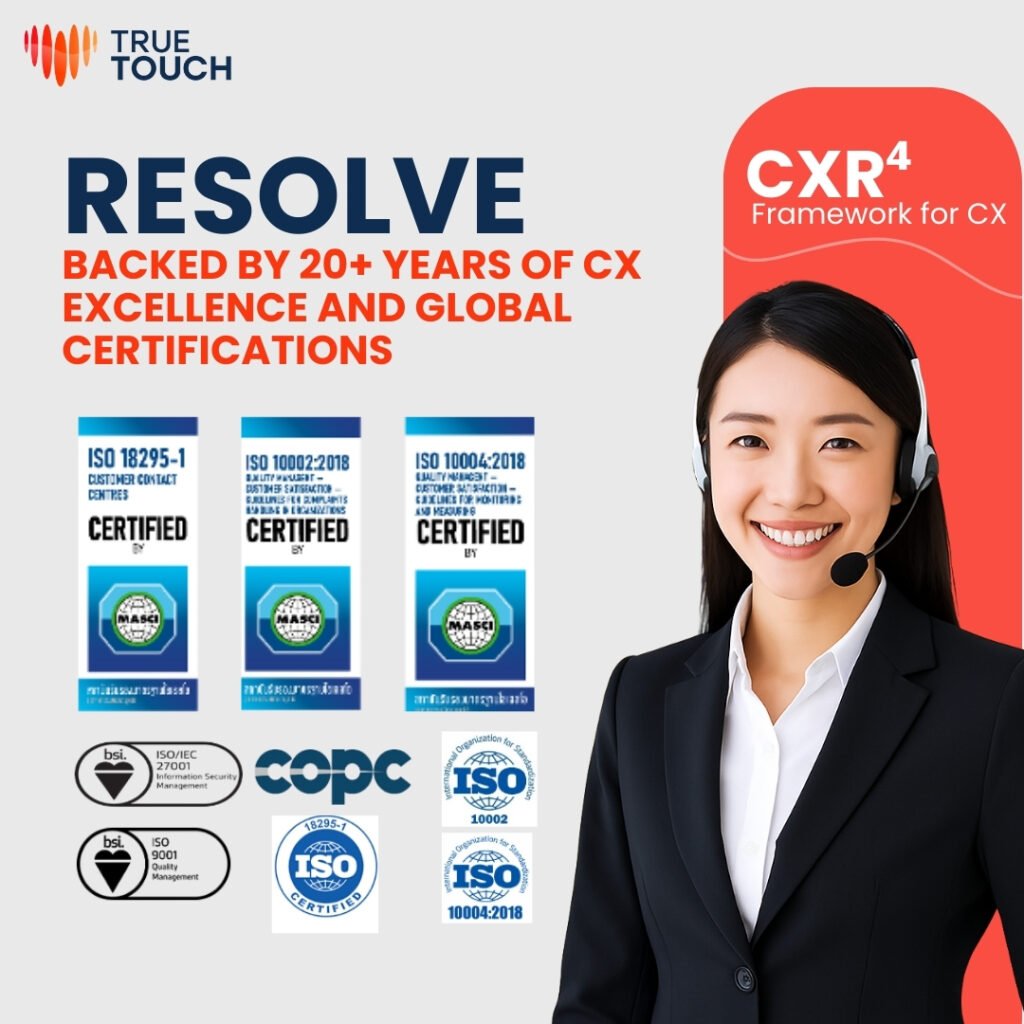
Resolve :
Using data to analyse root cause, FCR, complaints and repeat contacts, to resolve problems faster and more accurately
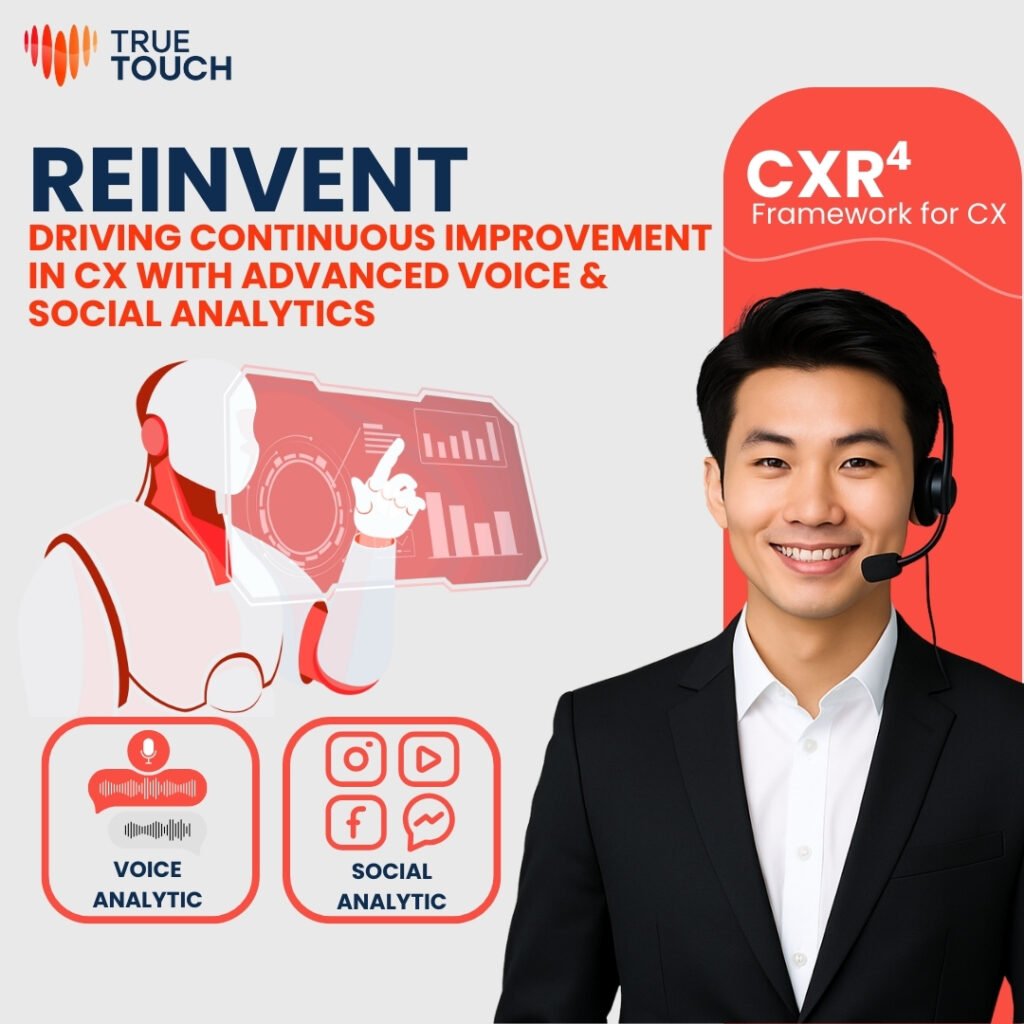
Reinvent :
Using voice analytics, AI analytics and social analytics to develop the customer experience continuously and keep up with customer expectations


True Touch and raising Data-Driven Customer Operations
True Touch has more than 20 years of experience providing Contact Center and customer experience solutions for organizations in both the public and private sectors in Thailand
Through the True Touch Total CX Solutions approach, True Touch helps organizations connect people, process, technology and data to create customer operations that are both efficient and genuinely measurable
covering
- Omnichannel Contact Center
- Voice of Customer Analytics
- AI Customer Experience
- Workforce Optimization
- Service Excellence Framework
- Operational Dashboard
- Customer Journey Improvement
For organizations that want to scale the business, Data-Driven Customer Operations is the key that makes growth not merely “faster” but “more accurate and more sustainable”
Related references
The ideas in this article line up with international standards and guidance on customer experience and Contact Center, such as
These sources show that the modern customer experience depends on data, AI, operational excellence and systematic quality management alike
In summary: a good CX has to be measurable and genuinely improvable
In 2026 the organizations that win are not the ones with the most data, but the ones that use data best
Data-Driven Customer Operations is therefore at the heart of CX transformation and operational excellence, because it helps an organization
- Understand customers deeply
- Fix problems at the root cause
- Measure CX genuinely
- Use AI more accurately
- and turn the Contact Center into a business insight hub
Used the right way, data makes the customer experience not merely a matter of feeling but a tool for creating business impact that can genuinely be measured
🚀 Raise your customer operations with data and AI at True Touch
Click here to contact us for a free plan If your organization is looking for a way to
- Use data to raise the customer experience
- Analyse the Voice of Customer systematically
- Build an operational dashboard that genuinely measures
- Develop an omnichannel Contact Center
- Use AI and analytics to increase the efficiency of customer operations
- Turn the Contact Center into a business insight hub
True Touch is ready to support your organization with more than 20 years of experience in Contact Center and customer experience solutions
to help your organization “Turn Customer Data into Measurable CX Impact”
📩 Contact us for a consultation or a demo at
📩 Contact us today to turn every customer voice into sustainable growth.
❓FAQ
Q1: What is Data-Driven Customer Operations?
A1: Data-Driven Customer Operations means running customer service using data from every touchpoint in order to analyse, measure and improve the customer experience systematically
Q2: Why does data matter to the customer experience?
A2: Because data lets an organization understand customers' pain points, see the root cause of a problem, and improve the service from real data rather than guesswork
Q3: How can a Contact Center use data to create business value?
A3: A Contact Center can use data from conversations, complaints, surveys and its various channels to analyse VOC, find insight and pass it on to the business to develop products, services and the customer journey
Q4: How is AI related to Data-Driven Customer Operations?
A4: AI needs quality data in order to analyse sentiment, anticipate problems, do smart routing and increase the efficiency of customer service
Q5: How should an organization start Data-Driven Customer Operations?
A5: Start by gathering data from every touchpoint, set KPIs that connect to business impact, build a dashboard to analyse root cause, and develop a process of continuous improvement