

Over the past few years, many organizations have adopted Chatbots, Voicebots, and Generative AI to answer questions, summarize conversations, and surface information for customer service agents.
But the next shift in Customer Operations is moving from AI that only "generates answers" toward AI that can assess a situation, plan, and carry out actions that help resolve the customer's problem.
This technology is called Agentic AI Customer Service, and it may become one of the defining components of the Contact Center and customer service work of the future.
That said, giving AI the ability to act raises important questions: how much decision-making authority should an organization grant it, which types of work still require human review, and what systems, data, and governance must be in place for AI to be used safely and effectively.
Agentic AI is an AI system that can carry out work to achieve a defined goal under an appropriate level of human oversight. It can take in information, analyze the situation, plan, select the right tools, and execute the appropriate steps.
IBM describes Agentic AI as being made up of AI Agents that handle sub-tasks to solve a problem, and that may coordinate with one another through a process of AI Orchestration.
Applied to customer service, Agentic AI Customer Service does more than answer questions — it can connect to your systems to carry out what the customer actually needs.
The key difference is not how naturally the AI can answer a question, but how far it can plan and act.
Capability | Traditional Chatbot | Generative AI | Agentic AI |
Answer general questions | Yes | Yes | Yes |
Understand natural language | Limited | Strong | Strong |
Generate new responses | Limited | Yes | Yes |
Plan across multiple steps | Limited | Partially | Core capability |
Connect to systems to take action | Only along a fixed flow | Requires integration | Chooses actions to meet the goal |
Check results and adjust the steps | Limited | Limited | Can be designed to do so |
Generative AI suits work that creates and summarizes information, while Agentic AI puts more weight on analysis, decision-making, and execution in order to reach a goal.
That said, Agentic AI does not operate freely without boundaries. The organization still has to define permissions, business rules, and guardrails that make clear which actions the AI is allowed to take.
In general the work can be broken into four key stages.
The AI analyzes text, voice, or data from the service channel to identify what the customer wants — an enquiry, a change of service, a refund, or a problem report.
The system works out which sources the information must come from, which steps are involved, and which systems it needs to connect to — CRM, Ticketing, Order Management, or Knowledge Management.
The AI calls the tools or systems it has been permitted to use — opening a case, changing an appointment date, creating a task, or checking a status.
If the action succeeds, the system reports the result and records the data. But when it meets a complex case, high risk, or something outside its scope, the AI hands over to an agent to take it from there.
Google Cloud notes that AI Agents can help handle questions, resolve problems, and support personalized service, freeing agents to spend their time on more complex cases.
Checking status, changing the delivery date, opening a request, or coordinating with the relevant department — without the customer having to contact several teams.
Gathering information from multiple systems, summarizing the customer's history, recommending the Next Best Action, and creating tasks for the Back Office team once the conversation ends.
Coordinating the workflow between Front Office and Back Office — a service change request, a document submission, or following a request through to completion.
An organization does not have to begin with the most complex use case. It is better to choose work with clear steps, ready data, and a level of risk that can be kept under control.
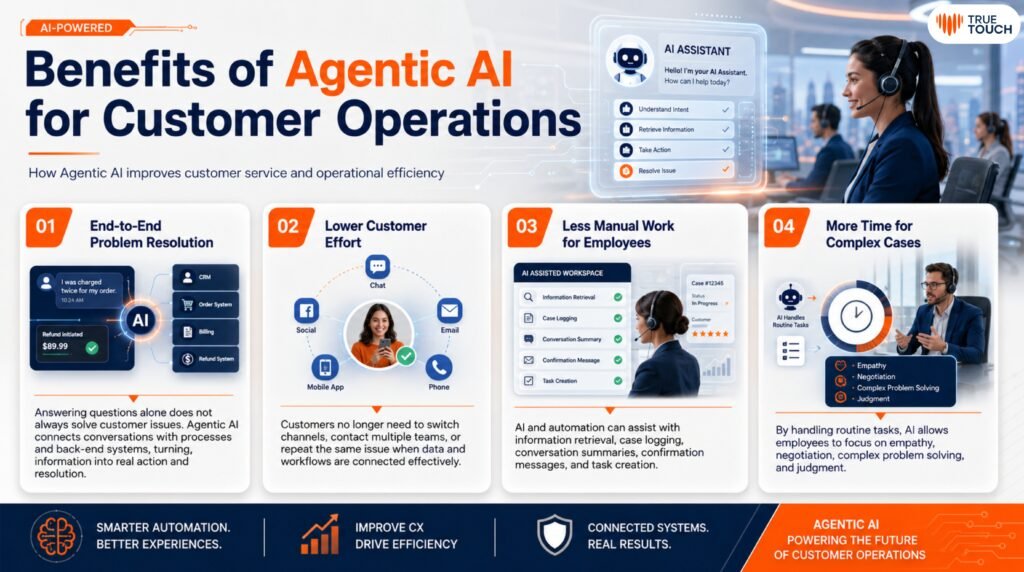
Being able to answer a question does not mean the customer's problem has been solved. Agentic AI connects the conversation to the process and back-office systems, moving from giving information to taking action that genuinely resolves the issue.
Customers no longer have to switch channels, contact several departments, or explain the same problem over and over — provided the data and workflow are properly connected.
Looking up information, logging cases, summarizing conversations, sending confirmation messages, and creating tasks are all work that AI and Automation can take on.
Once AI handles the standard work, agents can give their attention to cases that call for empathy, negotiation, on-the-spot problem solving, and judgement.
Because Agentic AI can act on systems and data, letting it operate without a governance framework carries considerably more risk for an organization than a Chatbot that only answers questions.
The NIST AI Risk Management Framework recommends that organizations apply trustworthiness and risk management across the full lifecycle of designing, developing, deploying, and evaluating AI systems.
In parallel, OWASP has catalogued the risks of Agentic Applications, including goal manipulation of the agent, misuse of tools, inappropriate permissions, and errors that cascade across multiple systems.
Yes — particularly for work involving sensitive data, finances, customer entitlements, policy exceptions, or any situation calling for empathy and human judgement.
What matters is that the handover carries everything the AI has already verified: the conversation history, the actions taken, and the recommended next step — so the customer never has to explain the problem from the beginning again.
Across more than 20 years of delivering Customer Service Solutions and Contact Center services, what True Touch has seen consistently is that technology produces good results when the organization prepares People, Process, Data, and Governance together.
AI projects that start from the questions "what problem does the customer have?" and "which process needs improving?" tend to have a far clearer direction than those that start by choosing a technology.
Begin by having the AI recommend or prepare information, then raise its level of action once the system has been tested and governance is in place.
Trial it with a subset of customers, channels, or transaction types to assess accuracy, impact, and risk before scaling.
Your metrics should cover Resolution Rate, Escalation Rate, Repeat Contact, Customer Satisfaction, Error Rate, and Cost per Resolution.
The goal is not to automate as much as possible, but to find the level of automation that resolves customer problems better without creating risk the organization cannot control.
Agentic AI Customer Service raises AI from a tool that helps answer questions to a system that can understand a goal, plan, and act to help resolve the customer's problem.
Success therefore does not rest on the AI's capability alone. It depends on a clear process, ready data, connected systems, Human-in-the-Loop, and appropriate AI Governance.
Organizations that start from the customer's problem, choose their use cases carefully, and pilot within a scope they can control will be able to turn Agentic AI from a technology trend into a business capability that delivers real results.
True Touch is ready to help your organization analyze the Customer Journey, assess readiness across Process, Data, and People, and design an approach to adopting AI and Automation that fits your business goals.
A1: Generative AI focuses on producing answers, summarizing information, and drafting text. Agentic AI can plan and carry out actions through connected systems — opening a case, changing an appointment, or creating a task — within the scope the organization defines.
A2: Agentic AI can reduce repetitive work, information lookups, and tasks with clear steps. But cases requiring empathy, negotiation, judgement, and high-impact decisions still need people. The agent's role therefore tends to shift toward handling complex cases and quality control.
A3: Start with work that has clear steps, ready data, low risk, and measurable outcomes — for example Agent Assist, Case Classification, Appointment Management, Order Status, or creating tasks for the Back Office team.