


In an era where AI has become part of how organizations work, the key question for many businesses is no longer "which AI should we use?" but "is our team ready to work alongside AI?" — particularly in Customer Operations and the Contact Center, where teams look after customers across many channels, handle large volumes of data, and must keep service standards consistent. Having AI technology alone may not be enough if agents, supervisors, and support teams still lack the skills to use it to its full potential.
This is why the idea of AI Skills Customer Operations has become central for modern organizations. The future of customer service does not rest on AI alone — it rests on the ability of people to use AI to raise service quality, working efficiency, and the customer experience.
AI Skills Customer Operations is the set of skills that lets a customer service team work effectively alongside AI — from understanding the basics of AI, to using AI tools in day-to-day work, analyzing customer data, verifying the accuracy of AI answers, and applying a human touch to look after customers in complex situations.
In a Customer Operations context, AI skills do not mean every employee must be able to write code or build AI models. They mean having enough understanding to use AI as a "working assistant" correctly, safely, and in a way that produces good business results.
AI Skills Customer Operations is therefore the set of skills that connects "technology" and "customer service" so they work together effectively.
2026 will be the period when many organizations start using AI in customer service at a deeper level — not just chatbots answering basic questions, but AI Agents, Voicebots, Speech Analytics, Sentiment Analysis, AI QA, Knowledge Assistants, and dashboards that analyze Customer Insight in real time.
As AI takes on more of the work, people's work changes too. Simple, repetitive, or clearly structured tasks are increasingly handled with AI's help, while the cases that reach an agent tend to be complex ones demanding more analysis, judgement, and empathy than before.
That means the customer service employee of the future will not simply be an "answerer of questions" but a "steward of the customer experience" — using AI as a working tool while applying human ability to build understanding, confidence, and a good relationship between customer and brand.
Organizations that build these skills sooner have the chance to gain an advantage in Service Quality, Productivity, Customer Satisfaction, and Business Impact.
From working in Contact Center and Customer Experience, one thing is clear: many organizations become interested in AI because they want more speed, lower cost, and better service. But the real challenge is rarely the technology alone.
Often an organization has good AI tools, yet the team is unsure how to use them, at which step, how far to trust the AI's answer, or when to hand over to a person. The result is that AI is never used to its full potential — and in some cases it introduces service-quality risk.
Conversely, organizations that start by preparing their people and processes tend to use AI more effectively, because the team understands AI's role, knows the tool's limits, and can turn AI output into genuine service improvements.
This shows that building AI Skills Customer Operations is not a one-off system training session. It is the design of a new way of working, in which people, technology, and the service process connect systematically.
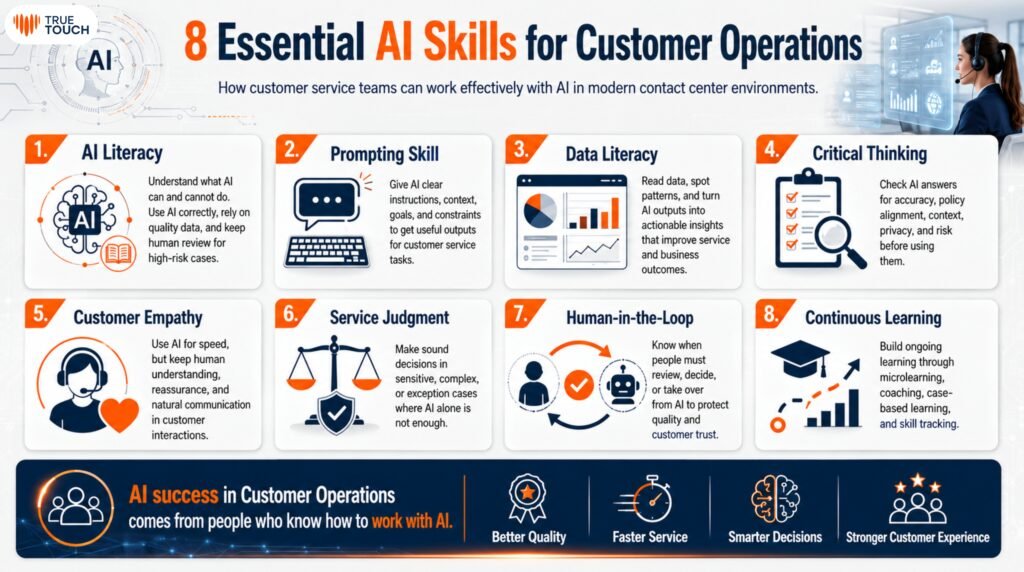
AI Literacy is the foundational skill everyone in Customer Operations should have — agents, supervisors, QA, trainers, and management alike.
It does not mean understanding the deep technical detail. It means understanding what AI can do, what it cannot, and how to apply it appropriately in customer service.
When employees have AI Literacy, it reduces fear, reduces misuse, and makes the team readier to bring AI into everyday work.
In the age of Generative AI, writing prompts has become an important skill across many roles, including Customer Operations — because the quality of the AI's answer usually depends on the quality of the instruction it is given.
A good prompt should carry clear context, a goal, and constraints — which customer segment the answer is for, what tone of language to use, which information must not be given, and what else must be checked before it goes to the customer.
Prompting skill is therefore not just typing a question. It is communicating with AI in a structured way so the output can genuinely be used.
Customer Operations holds a great deal of data: inbound volume, contact reasons, handling time, satisfaction scores, conversation quality, and customer complaints.
As AI analyzes that data faster, the team needs Data Literacy to read the AI's output and turn it into insight that leads to real improvement.
Data Literacy is the skill that stops the team at reading reports and lets them use data to drive action and business impact.
AI can make work faster, but AI is not always right — especially in customer service, where policy, service terms, personal data, and sensitive complaints are involved.
The Customer Operations team therefore needs critical thinking to assess AI answers before they are used, particularly on these points:
AI may suggest answers or summarize information quickly, but the customer's feelings still need to be heard and understood by a person.
Customer Empathy therefore matters more in the age of AI, because as AI takes on more of the basic work, the cases agents handle tend to be the ones where customers want reassurance, help, or emotional care more than before.
In customer service, not every situation has a straightforward answer. Some cases call for judgement — a sensitive complaint, a customer with a run of bad experiences, or a case requiring an exception.
Service Judgment is the skill of assessing the situation and choosing the right course, weighing service standards, risk, company policy, and the effect on the customer's experience.
AI can supply information or propose options, but decisions in significant cases still require a person who understands the context and can exercise judgement appropriately.
Working safely alongside AI requires Human-in-the-loop — defining the points where a person must review, decide, or take over from the AI.
This skill matters enormously for supervisors, QA, and Customer Operations management, because it lets AI work effectively without affecting quality or customer trust.
AI changes fast, tools change fast, and customer behaviour changes fast too. The Customer Operations team therefore needs the skill of continuous learning, rather than waiting for occasional training sessions.
With a continuous-learning mindset, adopting AI stops being a short-term project and becomes a core organizational capability.
AI is changing customer service quickly, but the organizations that gain the advantage will not always be the ones with the most AI tools. They will be the ones with teams who understand AI, use it effectively, and still keep a quality human touch in how they look after customers.
AI Skills Customer Operations is therefore a key capability for customer service teams in 2026, because it lets employees use AI to work more efficiently, check quality, analyze data, and make better decisions in real situations.
Once the team understands which skills are needed, the next step is designing how to build those AI skills in practice — from the role of team leaders, to designing training that fits the workflow, setting guidelines and governance, through to measuring business outcomes.
True Touch – Touch the heart of your customers
A1: AI Skills Customer Operations is the set of skills that lets a customer service team work effectively alongside AI — understanding the basics of AI, using prompts, reading and analyzing data, verifying AI answers, exercising service judgement, and applying a human touch in complex situations.
A2: The key skills for customer service teams in the age of AI are AI Literacy, Prompting Skill, Data Literacy, Critical Thinking, Customer Empathy, Service Judgment, and Continuous Learning — because a Customer Operations team must be able to use AI as a working tool while verifying the accuracy of the information and deciding appropriately in the customer's context.
A3: AI Skills Customer Operations let a service team use AI to find information, analyze customer insight, cut repetitive work, and respond faster — while employees still apply empathy, critical thinking, and service judgement to complex cases. The result is a better Customer Experience in speed, quality, accuracy, and understanding of the customer.