
Once an organization understands that AI Skills Customer Operations is the essential skill set for customer service teams in the age of AI, the next question is "how do we make those skills real in everyday work?"
AI Skills Development should not be treated as a single training session that introduces employees to an AI tool. Using AI in Customer Operations touches many dimensions at once — how employees think, how work flows, the data used to serve customers, quality standards, governance, and the measurement of business outcomes.
In a Contact Center and Customer Operations serving customers across many channels, employees do not just need to know how AI works. They need to understand which part of the job AI should help with, how far its answers can be trusted, which cases require human review, and how AI's output should feed back into service improvement.
AI Skills Development is therefore the process of building a customer service team's ability to use AI effectively, safely, and in a way that creates a better Customer Experience — not simply adding a new tool to existing work.
From working in Contact Center and Customer Experience, one thing is clear: organizations that succeed with AI rarely start by buying a tool alone. They start by redesigning the way work is done so it fits their people, their processes, and their business goals.
Many organizations already have a Chatbot, Voicebot, AI QA, Speech Analytics, or dashboards. But if the team does not know how to use that information, or if supervisors cannot turn AI insight into real coaching, those tools may still not deliver the results expected.
Conversely, teams whose leaders are ready to lead, who have clear guidelines, and whose workflow is designed so AI helps at the right points, tend to be far better at turning AI from an add-on tool into part of everyday work.
This is why AI Skills Development has to cover employees, team leaders, processes, and working standards — not just technical training.
Developing AI skills cannot succeed through employee training alone. Team leaders play a decisive role in making those skills real on the floor.
Supervisors and managers should act as coach, change leader, and quality guardian at once — helping the team understand how AI will support the work, how to use AI data to improve performance, and what to watch out for when AI is applied to real customers.
When team leaders understand this and are ready to lead, building AI Skills Customer Operations happens faster and lasts longer.
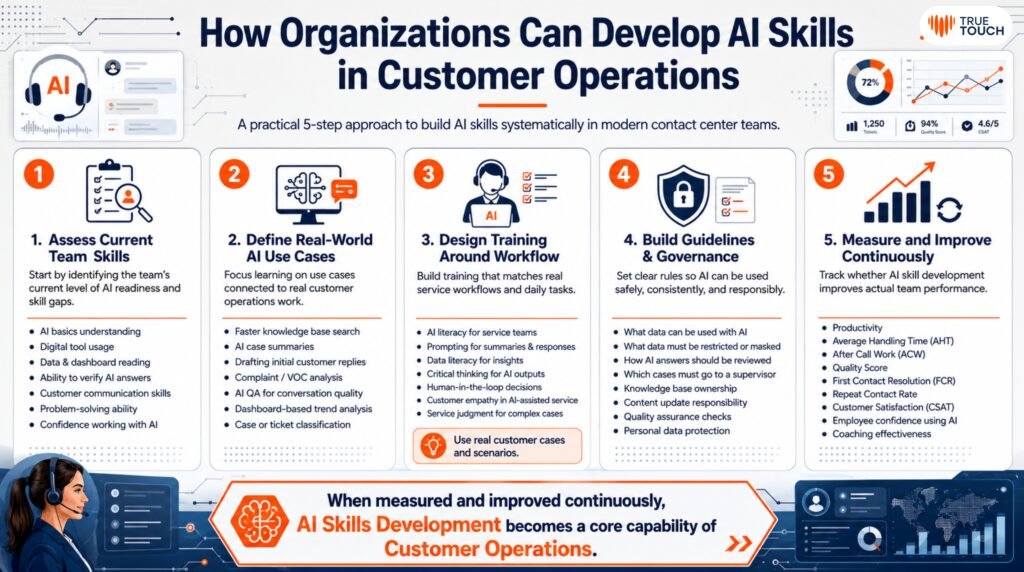
Starting AI Skills Development does not always require a large programme, but an organization should begin systematically with five key steps.
Start by surveying how well the team understands AI, how comfortable they are with digital tools, whether they can read data, whether they understand AI's limits, and which skills need building.
AI Skills Development should start from use cases connected to real problems on the floor — not broad AI teaching that leaves employees unsure how to apply any of it.
When employees see how AI helps their own work, learning comes more easily and AI stops feeling remote.
Good AI training should connect to the service team's real workflow — the steps before taking a case, during the conversation, after the case closes, when handing over, and when summarizing information to improve the service.
Training should use real examples — frequent complaints, complex customer questions, or situations where AI might give an incomplete answer — so employees practise thinking and deciding close to the real thing.
Using AI in customer service requires clear guidelines and governance, because it involves customer data, answer quality, credibility, and organizational risk.
AI Skills Development should be measured continuously — not just whether employees completed the training, but whether these skills help the team work better.
When an organization measures and improves continuously, AI Skills Development stops being a training project and becomes a core capability of the Customer Operations team.
When a customer service team has the skills to work alongside AI, the organization does not simply work faster. It can create business results on several fronts, such as:
AI is changing customer service quickly, but the organizations that gain the advantage will not always be the ones with the most AI tools. They will be the ones that develop their people to work best alongside AI. AI Skills Development is therefore the process that turns AI from a tool into a genuine capability of the customer service team, because it lets employees use AI to work more efficiently, check quality, analyze data, and still keep the human touch customers expect from the brand.
For organizations looking to raise the level of their Contact Center and Customer Operations, investing in AI Skills Development is an investment in the future of their employees, their customers, and their business.
True Touch is ready to partner with modern organizations to raise the level of their Customer Operations — from Contact Center strategy, to developing customer service team skills, designing workflows that work alongside AI, using Data & AI to improve service quality, and building a Customer Experience that serves the business over the long term.
Contact True Touch to discuss an AI Skills Development approach for your Customer Operations team and prepare your service team for what comes next
A1: AI Skills Development is the process of building a team's ability to work effectively alongside AI. It covers training, workflow design, guidelines, governance, and measuring the results of AI use in real work — so a Customer Operations team can use AI correctly, safely, and with genuine business results.
A2: Start by assessing the team's current skills, identifying AI use cases connected to real work, designing training that fits the workflow, setting guidelines for AI use, and defining KPIs to measure results across productivity, quality, Customer Experience, and employee confidence in using AI.
A3: AI Skills Development lets a customer service team use AI more effectively — cutting repetitive work, improving the accuracy of information, raising coaching quality, reducing repeat contacts, and improving Customer Experience measurably. When the team uses AI appropriately and understands its limits, the organization can raise productivity while better preserving service quality and the human touch.
1. Microsoft. 2025 Work Trend Index: The Year the Frontier Firm is Born.https://www.microsoft.com/en-us/worklab/work-trend-index/2025-the-year-the-frontier-firm-is-born
2. Gartner. Agentic AI and the Future of Customer Service.https://www.gartner.com/en/newsroom/press-releases/2025-03-05-gartner-predicts-agentic-ai-will-autonomously-resolve-80-percent-of-common-customer-service-issues-without-human-intervention-by-20290
3. McKinsey & Company. Superagency in the Workplace.https://www.mckinsey.com/capabilities/tech-and-ai/our-insights/superagency-in-the-workplace-empowering-people-to-unlock-ais-full-potential-at-work