
Preparing an organization for the age of AI does not end with choosing a tool or an automation platform. It has to start by building the readiness of "people" — so they understand their new role and can work alongside AI with confidence. This is the heart of AI Workforce Readiness: an organization's readiness to develop its people, processes, and ways of working to match the AI era.
For Customer Operations, the Contact Center, and Customer Experience, building AI Workforce Readiness matters enormously, because service teams face rising customer expectations, large volumes of data, and demands for speed, accuracy, and service quality that can genuinely be measured.
Preparing people for an AI Workforce should therefore not begin with teaching a tool alone. It should begin with building understanding across the whole system — Mindset, Skillset, Process, and Governance — so the organization can use AI effectively, safely, and with real business results.
Many organizations have started bringing AI into customer service — Chatbot, Voicebot, AI Agent Assist, Speech Analytics, AI QA, or automation workflows. But in many cases the technology does not deliver the expected result, because the team does not yet understand which part of the work AI will help with, how to use it, and when to hand over to a person.
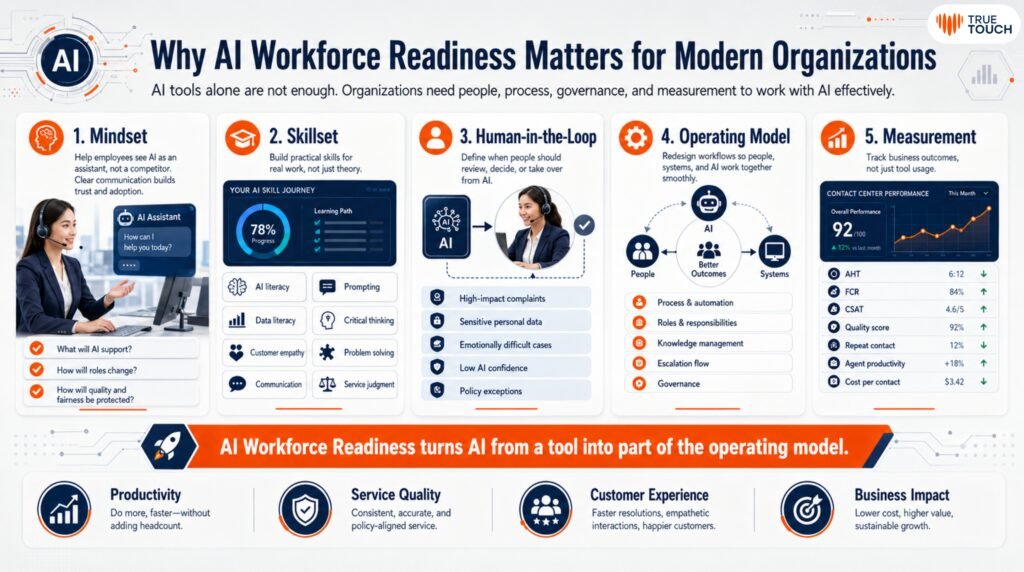
AI Workforce Readiness is therefore more than training employees to use an AI tool. It is preparing the whole organization to work with AI systematically, across five key dimensions:
With clear AI Workforce Readiness, AI stops being just a new tool and becomes part of an operating model that raises Productivity, Service Quality, Customer Experience, and Business Impact in concrete ways.
2026 will be the period when many organizations move from "trialling AI" to "using AI for real at an operational level", especially in customer-facing work — because businesses can no longer compete on speed alone. They must compete on quality, experience, and the ability to adapt.
As simple work is increasingly handled by self-service or bots, the cases that reach an employee tend to be complex ones demanding stronger analysis and communication skills.
Without AI or data-driven operations to help, the service team may never see the full picture of the customer — making problems slower and less consistent to resolve.
Employees need more than system skills. They need to understand how to work alongside AI, know its limits, and be able to use it to genuinely raise the quality of their work.
Organizations that prepare sooner have the chance to build an advantage in Productivity, Service Quality, Customer Experience, and Business Agility.
Employee anxiety is natural, especially when people hear that AI will do their work for them. Organizations should therefore start by communicating clearly that AI is being introduced to reduce repetitive work, improve accuracy, and give employees more time for the work that needs human ability.
In customer service, AI may answer basic questions, summarize conversations, analyze data, or suggest answers from the Knowledge Base. But employees keep the important role of listening, understanding context, deciding in complex situations, and communicating with a human touch.
When employees understand the purpose behind using AI, cooperation replaces resistance — and the organization can drive AI Workforce Readiness far more easily.
Building an AI Workforce has to focus on skills that work on the floor, especially in a Customer Operations team dealing constantly with customers, data, systems, and service processes.
These skills show that what is needed is not someone strong in technology alone, but someone who "can use technology" while still understanding people.
For organizations developing their customer service team's skills, training should connect to real situations — frequent complaints, complex customer questions, using AI to summarize a conversation, or using dashboard data to improve service quality.
AI may suggest answers, analyze data, or carry out some steps automatically. But in customer service, the organization must still define clearly when a person should review, decide, or take over.
Human-in-the-loop is one of the essential components, because it lets an organization use AI safely, with quality, and without eroding customer confidence.
Clear handover points let AI work effectively while preserving service standards and customer trust.
An AI Workforce cannot become real if the process stays entirely as it was. Organizations should therefore review their operating model across several dimensions, so people, systems, and AI work together smoothly.
Without adjusting the operating model, AI may end up as an add-on tool used well below its potential. But with the process designed appropriately, AI genuinely cuts repetitive work, adds speed, and raises the quality of the service team's work.
Investment in an AI Workforce should not be measured only by how many employees completed training or how often AI was used. It should connect clearly to business results and the customer experience.
With clear measurement, the organization sees that this is not merely a technology project but a strategy that creates business value and raises the customer service team's work over the long term.
Future Customer Operations is the customer service operating model of the future, driven by data, technology, and human capability, with the goal of serving customers faster, more accurately, more personally, and with clearer business results.
In this model it is the essential foundation, because it lets an organization genuinely prepare its people and processes to work alongside AI — not just to own the technology, but to have a team that understands it, can use it, and can control its quality. This lets the organization:
In other words, organizations looking to raise Customer Experience in 2026 should not only ask "which AI should we use?" but "how do we prepare our people and design our team to work well alongside AI?"
If most of the answers are still unclear, that does not mean the organization should not begin. It means the organization should start by putting the right AI Workforce Readiness framework in place before investing in or broadly expanding AI use.
AI Workforce Readiness means preparing people, processes, and technology to work together with purpose. It is not choosing AI because it is a trend, but designing the future of work so people can create higher value, with AI as the accelerator of efficiency.
For organizations that care about Customer Experience, 2026 will be the year to act in earnest — from building an AI mindset, to developing employee skills, adjusting the operating model, putting governance in place, and measuring results in a way that connects to business impact.
Because in the end, AI may help an organization work faster, but "people" remain the heart of service that understands, that can be trusted, and that builds a lasting relationship with the customer.
True Touch is ready to partner in designing and developing Customer Operations for modern organizations — from Contact Center strategy, to improving service processes, developing team skills, using Data & AI to raise service quality, and building a Customer Experience that serves the business over the long term.
Contact True Touch to discuss an approach to AI Workforce Readiness and Future Customer Operations that suits your organization
A1: AI Workforce Readiness is an organization's readiness to prepare its people, skills, processes, and governance to work effectively alongside AI — with the goal of raising productivity, improving service quality, and delivering a better Customer Experience.
A2: AI Workforce is the concept of people and AI working together. AI Workforce Readiness is the preparation that lets an organization actually build one — creating the mindset, developing skills, adjusting the workflow, and defining KPIs.
A3: The key skills are AI Literacy, Prompting Skill, Data Literacy, Critical Thinking, Customer Empathy, Problem Solving, Communication Skill, and Service Judgment — because employees must use AI as a tool while verifying, interpreting, and deciding appropriately in the customer's context.
2. Microsoft. (2025). 2025 Work Trend Index: The Year the Frontier Firm is Born.Read the Microsoft WorkLab report
3. Gartner. (2025). Gartner Predicts Agentic AI Will Autonomously Resolve 80% of Common Customer Service Issues by 2029.Read the Gartner analysis
4. McKinsey & Company. (2025). Superagency in the Workplace: Empowering People to Unlock AI's Full Potential at Work.Read the McKinsey & Company report